 📸 Photo
Photo: Earthshine.. at English Wikipedia · CC BY-SA 3.0 · Wikimedia Commons Source
Light-vented Bulbul
Pycnonotus sinensis (Light-vented Bulbul · シロガシラ)
💡 Everyday Comparisons for Size, Mass & Speed
- 💡 In Korea, it was first recorded on Eocheongdo in Jeollabuk-do in October 2002 and has since also been observed on Hongdo and Hataedo (National List of Species of Korea).
- 💡 It eats fruits and insects around orchards and farmlands (National List of Species of Korea).
Reference standards: coach bus ~12 m, mid-size car ~4.9 m, compact car ~1 t, basketball hoop 3.05 m, credit card 8.56 cm.
📖 1. Overview
The Light-vented Bulbul is a bulbul living in Taiwan and southern China, and sightings in Korea have been increasing on islands in the Yellow Sea.
🦴 2. Anatomy & Morphology
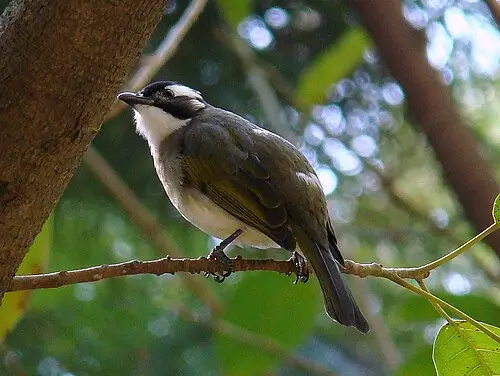
Males and females have the same coloring. The upperparts are dark greenish-gray, the forehead to the crown is black, and the crown to the back of the head is white. The ear coverts are blackish-brown with a small white spot, and the belly is dull white.
🔍 3. Ecology & Behavior
It feeds on fruits, insects, and spiders in trees. It flies in an undulating wave pattern, is relatively unwary, and perches on branches calling 'kkaek-kkaek'.
🇰🇷 4. Connection to Korea
According to the National List of Species of Korea, since it was first confirmed on Eocheongdo in Jeollabuk-do in October 2002, it has also been observed on Hataedo and Hongdo in Jeollanam-do, with records increasing.
📚 Sources & References
- • IUCN Red List LC (2018) — https://www.iucnredlist.org/species/22712643/132100908
- • IUCN Red List category LC — latest assessment at iucnredlist.org
- • doi.org — avilist.v2026
- • iucnredlist.org — 132100908
- • 국가생물종목록(국립생물자원관) ktsn 120000002016 — https://species.nibr.go.kr/home/mainHome.do?cont_link=009&subMenu=009002&contCd=009002&ktsn=120000002016
- • wikidata.org — Q1061015
- • commons.wikimedia.org — File:Chinese Bubul.JPG
- • species.nibr.go.kr — mainHome.do
- • Silhouette: PhyloPic — Andy Wilson · CC0 1.0 (Congeneric silhouette — Pycnonotus leucogenis)
Recorded dimensions are widely cited representative estimates from public literature and may vary by study or specimen.