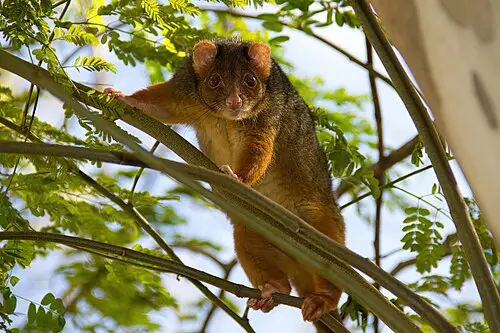
 📸 Photo
Photo: Andrew Mercer (www.baldwhiteguy.co.nz) · CC BY-SA 4.0 · Wikimedia Commons Source
Eastern Ring-tailed Possum
Pseudocheirus peregrinus (Eastern Ring-tailed Possum · ハイイロリングテイル)
💡 Everyday Comparisons for Size, Mass & Speed
- 💡 Its average weight of 700 g is about one and a half 500 mL bottles of water, and including its body-length tail it measures about 70 cm in total (Comparison).
- 💡 Its nest (drey) is 25–30 cm across, about the size of a large pizza (about 30 cm), and is built from shredded bark, twigs, and ferns (Comparison).
Reference standards: coach bus ~12 m, mid-size car ~4.9 m, compact car ~1 t, basketball hoop 3.05 m, credit card 8.56 cm.
Site-computed relative index from recorded values; not a formal scientific metric.
📖 1. Overview
The Eastern Ring-tailed Possum is the smallest of the 8 ringtail possum species living in Australia and inhabits dense scrub forests rich in eucalyptus.
🦴 2. Anatomy & Morphology
Its upperparts are brown to reddish and its underparts are pale gray. It has large eyes for good night vision, two opposable claws on each forefoot, and a nearly hairless prehensile tail.
🔍 3. Ecology & Behavior
At night it eats mainly eucalyptus leaves along with flowers, buds, nectar, and fruit, while its cecum breaks down leaf toxins. Small groups of one male, one or two females, and their young build nests called "dreys" in tree forks or dense shrubs.
🇰🇷 4. Connection to Korea
No direct record connecting this species to Korea has been found.
📚 Sources & References
- • IUCN Red List LC (2016) — https://www.iucnredlist.org/species/40581/21963019
- • IUCN Red List category LC — latest assessment at iucnredlist.org
- • mammaldiversity.org — 1000353
- • iucnredlist.org — 21963019
- • wikidata.org — Q928390
- • commons.wikimedia.org — File:Ringtail Possum. Brisbane.jpg
- • animaldiversity.org — Pseudocheirus peregrinus
- • Silhouette: PhyloPic — Rachel T Mason · CC0 1.0
Recorded dimensions are widely cited representative estimates from public literature and may vary by study or specimen.