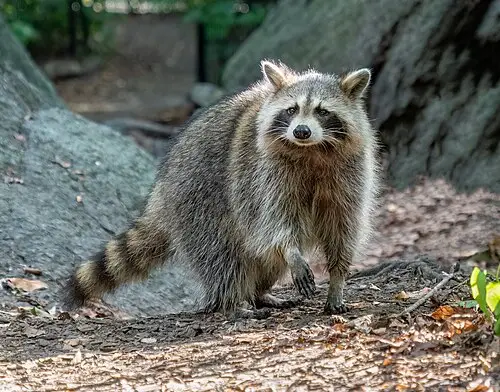
 📸 Photo
Photo: Rhododendrites · CC BY-SA 4.0 · Wikimedia Commons Source
Northern Raccoon
Procyon lotor (Northern Raccoon · アライグマ)
💡 Everyday Comparisons for Size, Mass & Speed
- 💡 Its body length of 95 cm is about 3.2 times the long side of an A4 sheet of paper (29.7 cm) (Comparison).
- 💡 Its average weight of 6 kg is 6 tenths of a 10 kg bag of rice (Comparison).
- 💡 In suburbs and cities, it feeds on garbage and uses attics, storm drains, and garages as dens (Animal Diversity Web).
Reference standards: coach bus ~12 m, mid-size car ~4.9 m, compact car ~1 t, basketball hoop 3.05 m, credit card 8.56 cm.
Site-computed relative index from recorded values; not a formal scientific metric.
📖 1. Overview
The Northern Raccoon is an omnivore characterized by a black mask across its eyes and a ringed tail, and it easily lives near human settlements. It has also been introduced and spread into parts of Asia and Europe.
🦴 2. Anatomy & Morphology
Its coat varies from gray to reddish-brown and pale yellowish-brown, and its tail has 4–10 black rings. Its forepaws look like slender human hands and are used with great dexterity, with 5 toes on both forefeet and hindfeet.
🔍 3. Ecology & Behavior
It eats fruits, nuts, and grains as well as crayfish, insects, frogs, fish, and bird eggs, consuming more invertebrates than vertebrates. Active at night, it survives winter on stored body fat rather than hibernating, and usually gives birth to 4 young per litter.
🇰🇷 4. Connection to Korea
No direct record connecting this species to Korea has been found.
📚 Sources & References
- • IUCN Red List LC (2016) — https://www.iucnredlist.org/species/41686/45216638
- • IUCN Red List category LC — latest assessment at iucnredlist.org
- • mammaldiversity.org — 1005892
- • iucnredlist.org — 45216638
- • wikidata.org — Q121439
- • commons.wikimedia.org — File:Raccoon in Central Park (35264).jpg
- • animaldiversity.org — Procyon lotor
- • Silhouette: PhyloPic — Margot Michaud · CC0 1.0
Recorded dimensions are widely cited representative estimates from public literature and may vary by study or specimen.