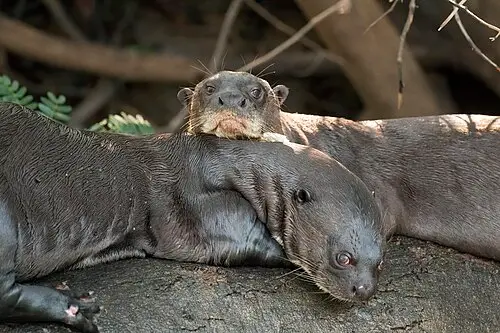
 📸 Photo
Photo: Charles J. Sharp · CC BY-SA 4.0 · Wikimedia Commons Source
Giant Otter
Pteronura brasiliensis (Giant Otter · オオカワウソ)
💡 Everyday Comparisons for Size, Mass & Speed
- 💡 Its weight of 24 kg equals the weight of twelve 2 L bottles of water (Comparison).
- 💡 Illegal hunting for its pelt still continues, and Indigenous groups use its meat and pelt for subsistence (Animal Diversity Web).
- 💡 A family clears a living site by trampling riverside vegetation and places 1–5 communal latrines around the perimeter to mark its territory (Animal Diversity Web).
Reference standards: coach bus ~12 m, mid-size car ~4.9 m, compact car ~1 t, basketball hoop 3.05 m, credit card 8.56 cm.
Site-computed relative index from recorded values; not a formal scientific metric.
📖 1. Overview
The Giant Otter is an otter living only in the major river systems of South America, where a mated pair and several generations of young form a family of 5–8 individuals. Each family uses a home range of about 12 km².
🦴 2. Anatomy & Morphology
Its average weight is known to be about 24 kg. It hunts mainly by sight, but in murky water it also uses hearing, smell, and touch together.
🔍 3. Ecology & Behavior
During the day, it catches fish such as catfish, perch, and characins along the edges of rivers and lakes. In shallow water it hunts alone, while in deep water the family dives together to drive fish toward the shore. Gestation lasts 65–70 days, and a litter usually has 2–3 young.
🇰🇷 4. Connection to Korea
No direct record connecting this species to Korea has been found.
📚 Sources & References
- • IUCN Red List EN (2023) — https://www.iucnredlist.org/species/18711
- • IUCN Red List category EN — latest assessment at iucnredlist.org
- • mammaldiversity.org — 1005852
- • iucnredlist.org — 18711
- • wikidata.org — Q83774
- • commons.wikimedia.org — File:Giant otters (Pteronura brasiliensis).jpg
- • animaldiversity.org — Pteronura brasiliensis
- • Silhouette: PhyloPic — Margot Michaud · CC0 1.0
Recorded dimensions are widely cited representative estimates from public literature and may vary by study or specimen.