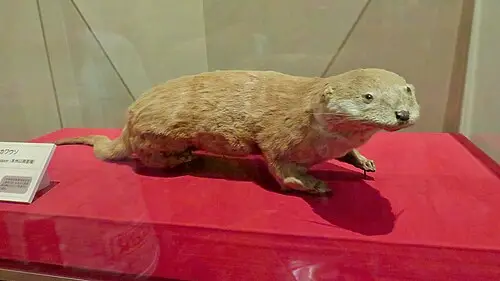
 📸 Photo
Photo: KKPCW · CC BY-SA 4.0 · Wikimedia Commons Source
Japanese Otter
Lutra nippon (Japanese Otter · ニホンカワウソ)
Not Evaluated (NE) on the IUCN Red List yet.
💡 Everyday Comparisons for Size, Mass & Speed
- 💡 On August 28, 2012, Japan's Ministry of the Environment announced its 4th Red List, classifying both subspecies of the Japanese Otter as Extinct.
- 💡 Japan designated the otter (Kawauso) as a Natural Monument on June 27, 1964, and the designation record notes that at the time it was confirmed only along the southwestern coast of Shikoku (Cultural Heritage Online).
Reference standards: coach bus ~12 m, mid-size car ~4.9 m, compact car ~1 t, basketball hoop 3.05 m, credit card 8.56 cm.
📖 1. Overview
The Japanese Otter lived in Japan until Japan's Ministry of the Environment reclassified both the Hokkaido subspecies and the southern subspecies (Honshu and southward) as Extinct (EX) in its August 2012 Red List revision. The last survival records were in 1955 for the Hokkaido subspecies and 1979 for the southern subspecies.
🦴 2. Anatomy & Morphology
Ministry of the Environment materials describe the Japanese Otter as a 'medium-sized mammal' unlikely to survive long without being noticed by people. Specific body length and weight figures were not found in official sources.
🔍 3. Ecology & Behavior
Cultural property records state that it lived mainly by the water, emerging at night from rock caves or thickets to eat fish and shellfish. Once common across Japan, its numbers plunged, and at the time of its designation in the 1960s it was confirmed only along the southwestern coast of Shikoku.
🇰🇷 4. Connection to Korea
No direct record connecting this species to Korea has been found.
📚 Sources & References
- • IUCN Red List: not evaluated (NE) — cross-checked with the Wikidata conservation-status entry
- • mammaldiversity.org — 1005849
- • wikidata.org — Q2122042
- • commons.wikimedia.org — File:Lutra nippon.jpg
- • env.go.jp — 15619.html
- • online.bunka.go.jp — 211810
- • Silhouette: PhyloPic — Ferran Sayol · CC0 1.0 (Congeneric silhouette — Lutra lutra)
Recorded dimensions are widely cited representative estimates from public literature and may vary by study or specimen.