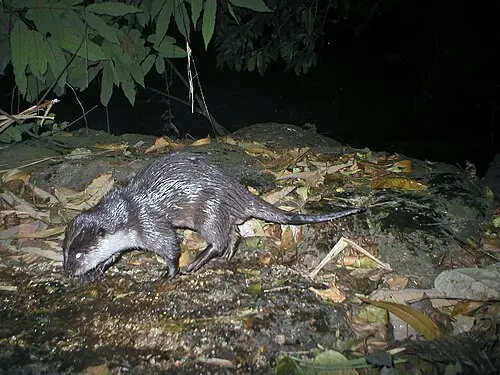
 📸 Photo
Photo: Clusteronefloyd · CC BY-SA 3.0 · Wikimedia Commons Source
Asian Small-clawed Otter
Lutra cinerea (Asian Small-clawed Otter · Asian Small-clawed Otter)
Not Evaluated (NE) on the IUCN Red List yet.
💡 Everyday Comparisons for Size, Mass & Speed
- 💡 Its head-and-body length of 63.5 cm is just over twice the long side of an A4 sheet of paper (29.7 cm) (Comparison).
- 💡 Its weight of 5.4 kg is similar to the weight of 2–3 bottles of 2 L water (Comparison).
- 💡 Farmers sometimes complain when it uproots rice in paddies, though it also eats small crabs that are crop pests (ADW).
Reference standards: coach bus ~12 m, mid-size car ~4.9 m, compact car ~1 t, basketball hoop 3.05 m, credit card 8.56 cm.
Site-computed relative index from recorded values; not a formal scientific metric.
📖 1. Overview
The Asian Small-clawed Otter lives from southern India to the southern coast of China, forming large family groups of about a dozen individuals that are mainly active during the day. It is often seen sliding and playing on muddy banks.
🦴 2. Anatomy & Morphology
Its claws are tiny and barely project beyond the tips of the toes, and its partially webbed feet give it great dexterity. Its coat is dark grayish-brown with a pale cream face and throat.
🔍 3. Ecology & Behavior
Unlike other otters, it searches for and catches prey with its forepaws rather than its mouth. It digs in waterside sand and mud for clams, mussels, and crabs, crushing their shells with broad, sturdy teeth. Mated pairs bond for life, and gestation lasts about 60 days.
🇰🇷 4. Connection to Korea
No direct record connecting this species to Korea has been found.
📚 Sources & References
- • IUCN Red List: not evaluated (NE) — cross-checked with the Wikidata conservation-status entry
- • mammaldiversity.org — 1005840
- • wikidata.org — Q109647344
- • animaldiversity.org — Aonyx cinerea
- • Silhouette: PhyloPic — Margot Michaud · CC0 1.0
Recorded dimensions are widely cited representative estimates from public literature and may vary by study or specimen.