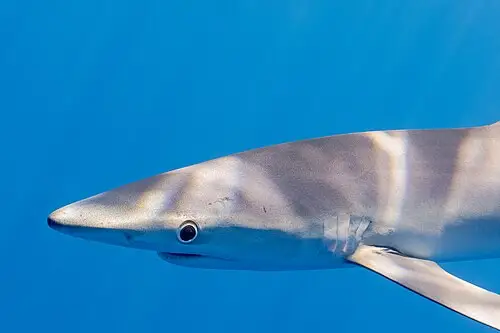
 📸 Photo
Photo: Diego Delso · CC BY-SA 4.0 · Wikimedia Commons Source
Blue shark
Prionace glauca (Blue shark · ヨシキリザメ)
💡 Everyday Comparisons for Size, Mass & Speed
- 💡 Its maximum total length of 4 m is close to the length of a passenger car (about 4.5 m) (Comparison).
- 💡 Its ADW body weight of 240 kg equals 12 bags of 20 kg rice (Comparison).
- 💡 Caught mainly as bycatch on longlines and gillnets targeting other fish, its fins, liver oil (squalene), and hide are traded commercially, while its meat has a low price due to high ammonia content (Animal Diversity Web).
Reference standards: coach bus ~12 m, mid-size car ~4.9 m, compact car ~1 t, basketball hoop 3.05 m, credit card 8.56 cm.
Site-computed relative index from recorded values; not a formal scientific metric.
📖 1. Overview
The blue shark is a pelagic shark with striking blue coloration that roams widely through the surface waters of temperate and tropical open oceans.
🦴 2. Anatomy & Morphology
Its back is deep indigo, its flanks are bright blue, and its belly is light gray, making it hard to spot in the sea. With a slender, streamlined body and long tail, it is counted among the fastest sharks.
🔍 3. Ecology & Behavior
It feeds most heavily on cephalopods such as squid and octopuses, and also eats fish such as herring, cod, and mackerel, small sharks, and seabirds. It is viviparous, giving birth to live young.
🇰🇷 4. Connection to Korea
It is a species recorded in Korea and listed in the National List of Species of Korea.
📚 Sources & References
- • IUCN Red List NT (2019) — https://www.iucnredlist.org/species/39381/2915850
- • IUCN Red List category NT — latest assessment at iucnredlist.org
- • catalogueoflife.org — 4MF6P
- • iucnredlist.org — 2915850
- • 국가생물종목록(국립생물자원관) ktsn 120000057304 — https://species.nibr.go.kr/home/mainHome.do?cont_link=009&subMenu=009002&contCd=009002&ktsn=120000057304
- • wikidata.org — Q26337
- • commons.wikimedia.org — File:Tiburón azul (Prionace glauca), canal Fayal-Pico, islas
- • fishbase.se — Prionace-glauca.html
- • animaldiversity.org — Prionace glauca
- • Silhouette: PhyloPic — Fidji Berio · CC0 1.0
Recorded dimensions are widely cited representative estimates from public literature and may vary by study or specimen.