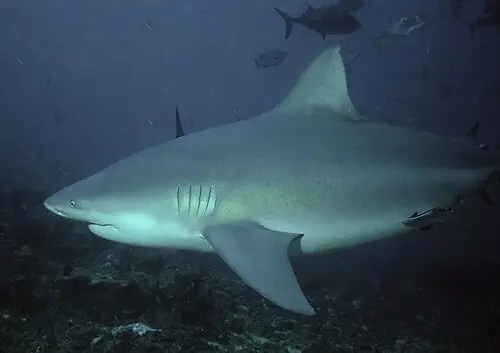
 📸 Photo
Photo: Pterantula · CC BY 2.5 · Wikimedia Commons Source
Bull shark
Carcharhinus leucas (Bull shark · オオメジロザメ)
💡 Everyday Comparisons for Size, Mass & Speed
- 💡 Its maximum total length of 4 m is close to the length of a passenger car (about 4.5 m) (Comparison).
- 💡 The average weight of an adult female, 111 kg, is the weight of 5–6 bags of rice weighing 20 kg each (Comparison, Animal Diversity Web).
- 💡 Although sometimes displayed in aquariums, many facilities avoid keeping it because it eats all the other fish in the same tank (Animal Diversity Web).
Reference standards: coach bus ~12 m, mid-size car ~4.9 m, compact car ~1 t, basketball hoop 3.05 m, credit card 8.56 cm.
Site-computed relative index from recorded values; not a formal scientific metric.
📖 1. Overview
The Bull shark is one of the few sharks that move between saltwater and freshwater, traveling far up rivers and into lakes, and is the only shark able to stay in freshwater for long periods.
🦴 2. Anatomy & Morphology
It has a very short snout, with a light to dark gray back and a white belly. Females are larger than males, and juveniles are brownish gray with black tips on their fins.
🔍 3. Ecology & Behavior
It feeds on prey near the bottom such as sea catfishes, stingrays, crabs, and mullets, and eats other sharks as it grows older. It gives birth in estuaries, where the young stay and use the estuary as a nursery until water temperatures drop.
🇰🇷 4. Connection to Korea
No direct record connecting this species to Korea has been found.
📚 Sources & References
- • IUCN Red List VU (2021) — https://www.iucnredlist.org/species/39372/2910670
- • IUCN Red List category VU — latest assessment at iucnredlist.org
- • catalogueoflife.org — KV3M5
- • iucnredlist.org — 2910670
- • wikidata.org — Q190469
- • commons.wikimedia.org — File:Bullshark Beqa Fiji 2007.jpg
- • fishbase.se — Carcharhinus-leucas.html
- • animaldiversity.org — Carcharhinus leucas
- • Silhouette: PhyloPic — author not recorded · Public Domain Mark 1.0
Recorded dimensions are widely cited representative estimates from public literature and may vary by study or specimen.