 📸 Photo
Photo: Albert kok · CC BY-SA 3.0 · Wikimedia Commons Source
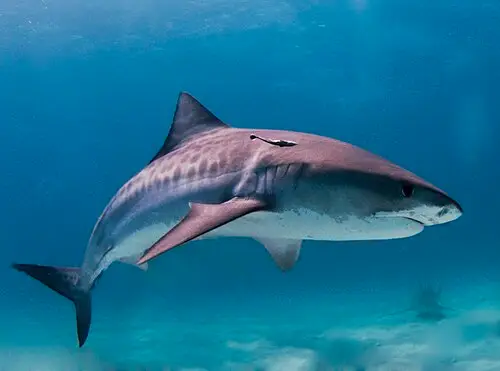
Tiger shark
Galeocerdo cuvier (Tiger shark · イタチザメ)
💡 Everyday Comparisons for Size, Mass & Speed
- 💡 Its maximum total length of 7.5 m is more than one and a half passenger cars (about 4.5 m each) (Comparison).
- 💡 The upper end of its weight range in ADW, 862 kg, is slightly over half the weight of a passenger car (about 1.5 tons) (Comparison).
- 💡 Because it is strong and leaps when hooked, it is a popular game fish usually caught and released for sport (Animal Diversity Web).
Reference standards: coach bus ~12 m, mid-size car ~4.9 m, compact car ~1 t, basketball hoop 3.05 m, credit card 8.56 cm.
Site-computed relative index from recorded values; not a formal scientific metric.
📖 1. Overview
The Tiger shark is one of the largest carnivores in the ocean, living along shallow coasts, estuaries, and around atolls in warm seas. Juveniles have tiger-like stripes that fade as they grow.
🦴 2. Anatomy & Morphology
It has a wedge-shaped head and a blunt nose, with a blue or green back and a pale yellow or white belly. Its serrated teeth can tear flesh and crack right through sea turtle shells and bones.
🔍 3. Ecology & Behavior
It feeds on mollusks, birds, snakes, crustaceans, sea turtles, and dugongs, and also scavenges dead or injured whales. It is an ambush hunter that uses its coloration for camouflage as it approaches prey, and does not pursue prey at length if it flees.
🇰🇷 4. Connection to Korea
It is a species recorded in Korea and listed on the National List of Species of Korea.
📚 Sources & References
- • IUCN Red List NT (2019) — https://www.iucnredlist.org/species/39378/2913541
- • IUCN Red List category NT — latest assessment at iucnredlist.org
- • catalogueoflife.org — 3F3KT
- • iucnredlist.org — 2913541
- • 국가생물종목록(국립생물자원관) ktsn 120000057302 — https://species.nibr.go.kr/home/mainHome.do?cont_link=009&subMenu=009002&contCd=009002&ktsn=120000057302
- • wikidata.org — Q188212
- • commons.wikimedia.org — File:Tiger shark.jpg
- • fishbase.se — Galeocerdo-cuvier.html
- • animaldiversity.org — Galeocerdo cuvier
- • Silhouette: PhyloPic — Amy Beauvois · CC0 1.0
Recorded dimensions are widely cited representative estimates from public literature and may vary by study or specimen.