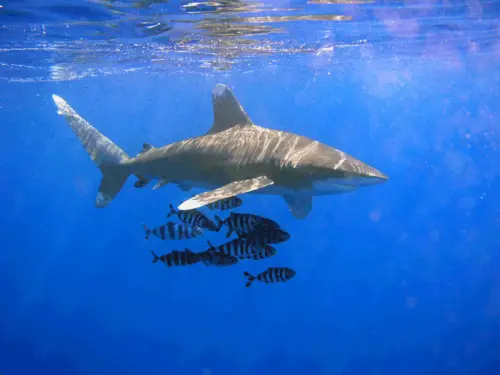
 📸 Photo
Photo: The original uploader was OldakQuill at English Wikipedia . · CC BY-SA 3.0 · Wikimedia Commons Source
Oceanic whitetip shark
Carcharhinus longimanus (Oceanic whitetip shark · ヨゴレ)
💡 Everyday Comparisons for Size, Mass & Speed
- 💡 Its maximum total length of 4 m is close to the length of a passenger car (about 4.5 m) (Comparison).
- 💡 Its average weight of 170 kg is the weight of 8–9 bags of rice weighing 20 kg each (Comparison).
- 💡 Its large dorsal fin is used as an ingredient in shark fin soup, and it is sometimes caught for finning, where only the fins are sliced off and the body is discarded (Animal Diversity Web).
Reference standards: coach bus ~12 m, mid-size car ~4.9 m, compact car ~1 t, basketball hoop 3.05 m, credit card 8.56 cm.
Site-computed relative index from recorded values; not a formal scientific metric.
📖 1. Overview
The Oceanic whitetip shark is an open-ocean shark of tropical surface waters that follows ships or pods of whales, and has white tips on its fins.
🦴 2. Anatomy & Morphology
It is named for the white mottled markings covering the tips of its first dorsal, pectoral, caudal, and pelvic fins. It has a stocky body, a short and blunt snout, and long, rounded fins. Its back is brown to grayish-brown, and its belly is white.
🔍 3. Ecology & Behavior
It is an apex predator at the top of the food chain that opportunistically feeds on bony fishes and squid, and sometimes seabirds, sea turtles, and rays. It gathers around ships, follows whale pods such as short-finned pilot whales, and often joins feeding frenzies where multiple sharks compete over food.
🇰🇷 4. Connection to Korea
No direct record connecting this species to Korea has been found.
📚 Sources & References
- • IUCN Red List CR (2019) — https://www.iucnredlist.org/species/39374/2911619
- • IUCN Red List category CR — latest assessment at iucnredlist.org
- • catalogueoflife.org — R3P4
- • iucnredlist.org — 2911619
- • wikidata.org — Q318090
- • commons.wikimedia.org — File:Oceanic Whitetip Shark.png
- • fishbase.se — Carcharhinus-longimanus.html
- • animaldiversity.org — Carcharhinus longimanus
- • fisheries.noaa.gov — oceanic-whitetip-shark
- • Silhouette: PhyloPic — Margot Michaud · CC0 1.0 (Congeneric silhouette — Carcharhinus obscurus)
Recorded dimensions are widely cited representative estimates from public literature and may vary by study or specimen.