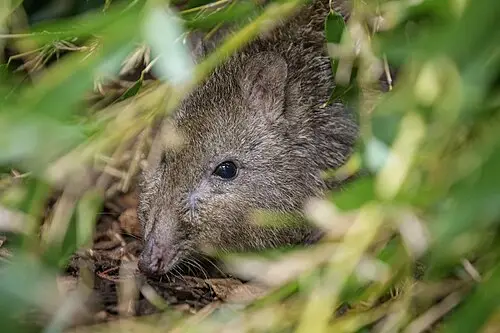
 📸 Photo
Photo: Petr Hamerník · CC BY-SA 4.0 · Wikimedia Commons Source
Long-nosed Potoroo
Potorous tridactylus (Long-nosed Potoroo · ハナナガネズミカンガルー)
💡 Everyday Comparisons for Size, Mass & Speed
- 💡 Its maximum weight of 1.8 kg is slightly lighter than a 2 L bottle of water (about 2 kg), and its maximum body length of 40 cm is about the size of a rabbit (Comparison).
- 💡 Because its chromosomes are few in number and large in size, its kidney and testis cells have been used in tissue culture research.
Reference standards: coach bus ~12 m, mid-size car ~4.9 m, compact car ~1 t, basketball hoop 3.05 m, credit card 8.56 cm.
Site-computed relative index from recorded values; not a formal scientific metric.
📖 1. Overview
The Long-nosed Potoroo is a rabbit-sized member of the kangaroo group that builds nests of grass and dry plants in dense forest undergrowth in Australia.
🦴 2. Anatomy & Morphology
It has an elongated muzzle and straight, soft fur that is gray or chestnut-brown above and grayish-white below. The central claws on its forefeet are long and sharp, used for scratching and digging in the ground.
🔍 3. Ecology & Behavior
An omnivore, it digs shallow holes to eat mainly fungi (mushrooms), grass roots, and tubers, as well as insects and larvae. It is active at night and usually lives alone.
🇰🇷 4. Connection to Korea
No direct record connecting this species to Korea has been found.
📚 Sources & References
- • IUCN Red List NT (2020) — https://www.iucnredlist.org/species/41511/166499137
- • IUCN Red List category NT — latest assessment at iucnredlist.org
- • mammaldiversity.org — 1000330
- • iucnredlist.org — 166499137
- • wikidata.org — Q275608
- • commons.wikimedia.org — File:D85 2097 export.jpg
- • animaldiversity.org — Potorous tridactylus
- • Silhouette: PhyloPic — Rachel T Mason · CC0 1.0
Recorded dimensions are widely cited representative estimates from public literature and may vary by study or specimen.