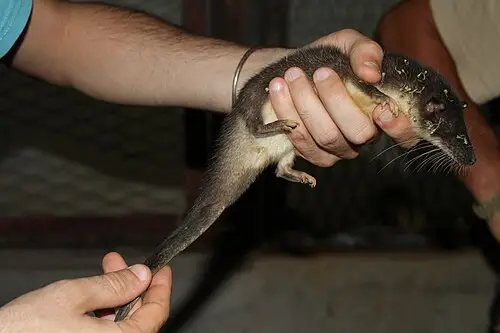
 📸 Photo
Photo: Julien Renoult · CC BY 4.0 · Wikimedia Commons Source
Giant Otter-shrew
Potamogale velox (Giant Otter-shrew · ポタモガーレ)
💡 Everyday Comparisons for Size, Mass & Speed
- 💡 Its maximum weight of 0.95 kg is almost the same as a 1 kg bag of sugar (Comparison). Its length of 64 cm is about 2/3 of a 1 m tape measure (Comparison).
- 💡 It travels up to 800 m in a night looking for food, a distance that takes a person about 10 minutes walking at 5 km per hour (Comparison).
Reference standards: coach bus ~12 m, mid-size car ~4.9 m, compact car ~1 t, basketball hoop 3.05 m, credit card 8.56 cm.
Site-computed relative index from recorded values; not a formal scientific metric.
📖 1. Overview
The Giant Otter-shrew is an otter-like mammal living along waters in the central African rainforest, named for its resemblance to an otter.
🦴 2. Anatomy & Morphology
It has stiff whiskers on a broad, flat muzzle and skin flaps that cover its nostrils when diving. It swims by moving its laterally flattened tail like a fish.
🔍 3. Ecology & Behavior
At night it hunts by touch and scent in calm pools, eating crabs, frogs, and fish. During the day it rests in bank burrows with underwater entrances.
🇰🇷 4. Connection to Korea
No direct record connecting this species to Korea has been found.
📚 Sources & References
- • IUCN Red List LC (2016) — https://www.iucnredlist.org/species/18095/97203526
- • IUCN Red List category LC — latest assessment at iucnredlist.org
- • mammaldiversity.org — 1000488
- • iucnredlist.org — 97203526
- • wikidata.org — Q474780
- • commons.wikimedia.org — File:Potamogale velox 340101862.jpg
- • animaldiversity.org — Potamogale velox
- • Silhouette: PhyloPic — author not recorded · Public Domain Mark 1.0
Recorded dimensions are widely cited representative estimates from public literature and may vary by study or specimen.