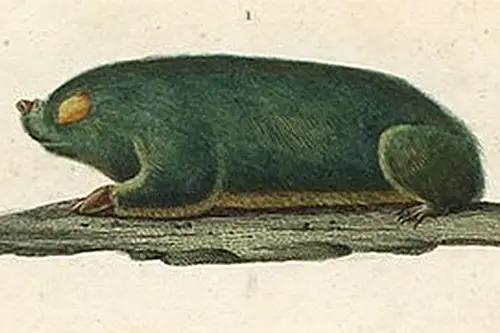
 📸 Photo
Photo: J. G. Pretre · Public domain · Wikimedia Commons Source
Cape Golden Mole
Chrysochloris asiatica (Cape Golden Mole · Cape Golden Mole)
💡 Everyday Comparisons for Size, Mass & Speed
- 💡 Its maximum weight of 47 g is lighter than a chicken egg (around 60 g) (Comparison). A burrow length of about 200 m is roughly the length of two soccer fields (around 105 m each) placed end to end (Comparison).
- 💡 Animal Diversity Web notes that although it brings no major direct economic gain to humans, it helps reduce pests by eating insects that damage garden plants.
Reference standards: coach bus ~12 m, mid-size car ~4.9 m, compact car ~1 t, basketball hoop 3.05 m, credit card 8.56 cm.
Site-computed relative index from recorded values; not a formal scientific metric.
📖 1. Overview
The Cape Golden Mole is a small mammal living in underground burrows, found across varied habitats from sandy soils and coasts to mountains and cities.
🦴 2. Anatomy & Morphology
It has a sleek body, short forelimbs with strong claws, and a leathery pad at the tip of its nose suited for digging. No tail is visible externally, and its dark brown fur shows green or purple iridescence depending on the light.
🔍 3. Ecology & Behavior
At night or around dawn and dusk, it feeds on insects and small invertebrates, detecting ground vibrations from prey with its enlarged middle-ear bones. Its burrows can reach about 200 m in length.
🇰🇷 4. Connection to Korea
No direct record connecting this species to Korea has been found.
📚 Sources & References
- • IUCN Red List LC (2015) — https://www.iucnredlist.org/species/40600/21288387
- • IUCN Red List category LC — latest assessment at iucnredlist.org
- • mammaldiversity.org — 1000478
- • iucnredlist.org — 21288387
- • wikidata.org — Q2313420
- • commons.wikimedia.org — File:Chrysochloris asiatica.png
- • animaldiversity.org — Chrysochloris asiatica
Recorded dimensions are widely cited representative estimates from public literature and may vary by study or specimen.