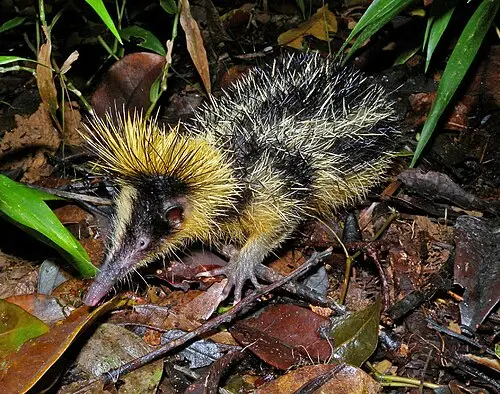
 📸 Photo
Photo: Frank Vassen · CC BY 2.0 · Wikimedia Commons Source
Lowland Streaked Tenrec
Hemicentetes semispinosus (Lowland Streaked Tenrec · Lowland Streaked Tenrec)
💡 Everyday Comparisons for Size, Mass & Speed
- 💡 Its average length of 14 cm is similar to the length of a ballpoint pen, and its maximum weight of 280 g is close to five chicken eggs (about 60 g each) (Comparison).
- 💡 Animal Diversity Web notes that related tenrecs have been proposed as 'mini-livestock' raised for meat, so this species could likewise be viewed as an exotic game meat.
Reference standards: coach bus ~12 m, mid-size car ~4.9 m, compact car ~1 t, basketball hoop 3.05 m, credit card 8.56 cm.
Site-computed relative index from recorded values; not a formal scientific metric.
📖 1. Overview
The Lowland Streaked Tenrec is a tenrec living in the lowland tropical rainforests of Madagascar whose body is covered in black and yellow quills.
🦴 2. Anatomy & Morphology
Its black and yellow quills feature four longitudinal yellow stripes—one running down the middle of the snout and the other three along the body.
🔍 3. Ecology & Behavior
Active during the day as well, it feeds mainly on earthworms and appears to stamp the ground with its forepaws to stir worms into moving. It sometimes enters brief periods of torpor, and up to 23 individuals may share a burrow during the breeding season.
🇰🇷 4. Connection to Korea
No direct record connecting this species to Korea has been found.
📚 Sources & References
- • IUCN Red List LC (2016) — https://www.iucnredlist.org/species/40593/97189434
- • IUCN Red List category LC — latest assessment at iucnredlist.org
- • mammaldiversity.org — 1000517
- • iucnredlist.org — 97189434
- • wikidata.org — Q265167
- • commons.wikimedia.org — File:Lowland Streaked Tenrec, Mantadia, Madagascar.jpg
- • animaldiversity.org — Hemicentetes semispinosus
- • Silhouette: PhyloPic — author not recorded · CC0 1.0 (Related taxon silhouette — Geogale aurita)
Recorded dimensions are widely cited representative estimates from public literature and may vary by study or specimen.