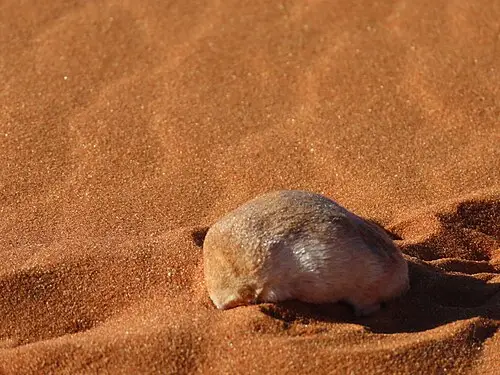
 📸 Photo
Photo: no rights reserved · CC0 · Wikimedia Commons Source
Grant's Golden Mole
Eremitalpa granti (Grant's Golden Mole · サバクキンモグラ)
💡 Everyday Comparisons for Size, Mass & Speed
- 💡 Its maximum body length of 85 mm is almost the same as the long side of a credit card (about 85.6 mm), and its maximum weight of 32 g is about four Korean 500-won coins (about 7.7 g each) (Comparison).
- 💡 Animal Diversity Web notes that its long, soft, iridescent fur may have economic value and that it helps control pests such as termites.
Reference standards: coach bus ~12 m, mid-size car ~4.9 m, compact car ~1 t, basketball hoop 3.05 m, credit card 8.56 cm.
Site-computed relative index from recorded values; not a formal scientific metric.
📖 1. Overview
Grant's Golden Mole is the smallest species in the golden mole family, 'swimming' through the sand of coastal desert dunes.
🦴 2. Anatomy & Morphology
Its body is spindle-shaped and flattened from top to bottom, with no visible tail. Its fur is softer and longer than that of other golden moles, grayish pale yellow with a silvery sheen.
🔍 3. Ecology & Behavior
Solitary and nocturnal, it forages on the surface at night for termites, other sand-dwelling invertebrates, and lizards. Because the loose sand collapses behind it so burrows do not last, by day it digs about 50 cm deep and rests in torpor with a lowered metabolic rate.
🇰🇷 4. Connection to Korea
No direct record connecting this species to Korea has been found.
📚 Sources & References
- • IUCN Red List LC (2015) — https://www.iucnredlist.org/species/7994/21283661
- • IUCN Red List category LC — latest assessment at iucnredlist.org
- • mammaldiversity.org — 1000485
- • iucnredlist.org — 21283661
- • wikidata.org — Q965668
- • commons.wikimedia.org — File:Grant's golden mole (Eremitalpa granti) 1.jpg
- • animaldiversity.org — Eremitalpa granti
Recorded dimensions are widely cited representative estimates from public literature and may vary by study or specimen.