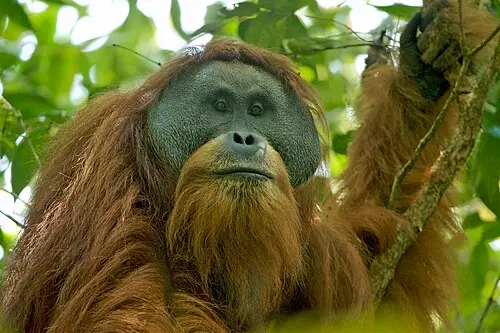
 📸 Photo
Photo: Tim Laman · CC BY 4.0 · Wikimedia Commons Source
Tapanuli Orangutan
Pongo tapanuliensis (Tapanuli Orangutan · タパヌリオランウータン)
💡 Everyday Comparisons for Size, Mass & Speed
- 💡 The remaining population of fewer than 800 individuals is about the size of a single school's student body, making it the rarest of all great apes (Comparison).
- 💡 Because it is also found at low density in mixed agroforests where people grow tree crops along the edge of primary forest, places where human farmland meets wild forest are also part of its habitat.
Reference standards: coach bus ~12 m, mid-size car ~4.9 m, compact car ~1 t, basketball hoop 3.05 m, credit card 8.56 cm.
📖 1. Overview
The Tapanuli Orangutan is an orangutan species described in 2017 that lives only in small forest fragments around Batang Toru, south of Lake Toba in Sumatra.
🦴 2. Anatomy & Morphology
It has a relatively slender build and cinnamon-colored, frizzy hair. Dominant males have a prominent mustache and flat cheek pads covered in downy hair, and females also have beards.
🔍 3. Ecology & Behavior
Its range covers about 1,000 km² and fewer than 800 individuals remain. Population density is highest in primary forest, though it is also found at low density in agroforestry areas along the forest edge.
🇰🇷 4. Connection to Korea
No direct record connecting this species to Korea has been found.
📚 Sources & References
- • IUCN Red List CR (2024) — https://www.iucnredlist.org/species/120588639/259042400
- • IUCN Red List category CR — latest assessment at iucnredlist.org
- • mammaldiversity.org — 1000723
- • iucnredlist.org — 259042400
- • wikidata.org — Q42564025
- • commons.wikimedia.org — File:Pongo tapanuliensis.jpg
- • doi.org — j.cub.2017.09.047
- • researchonline.ljmu.ac.uk — 7484
- • Silhouette: PhyloPic — based on video by Orangutan Outreach (youtube.com/watch?v=bWd1A9AWtWo) · CC BY 4.0
Recorded dimensions are widely cited representative estimates from public literature and may vary by study or specimen.