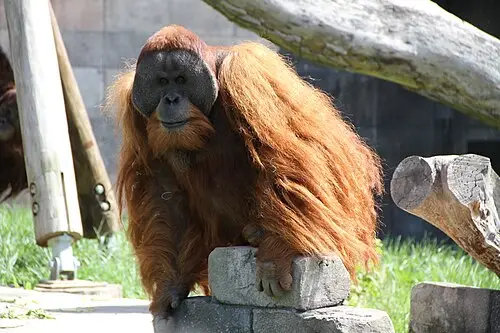
 📸 Photo
Photo: Andrew Regan · CC BY 3.0 · Wikimedia Commons Source
Sumatran Orangutan
Pongo abelii (Sumatran Orangutan · スマトラオランウータン)
💡 Everyday Comparisons for Size, Mass & Speed
- 💡 A male's maximum weight of 90 kg equals four and a half 20 kg bags of rice (Comparison).
- 💡 Its 2.25 m arm span is much longer than the outstretched arms of a 1.8 m tall adult (Comparison).
- 💡 It is regarded as an "umbrella species" whose forest protection safeguards other coexisting organisms, while illegal pet trade still continues (Animal Diversity Web).
Reference standards: coach bus ~12 m, mid-size car ~4.9 m, compact car ~1 t, basketball hoop 3.05 m, credit card 8.56 cm.
Site-computed relative index from recorded values; not a formal scientific metric.
📖 1. Overview
The Sumatran Orangutan is the largest non-human primate in Asia and the largest arboreal primate, covered in long, fine red hair.
🦴 2. Anatomy & Morphology
Its arms are very long, reaching an arm span of 2.25 m, while its legs are relatively small and weak. Males have large cheek pads covered in fine white hair.
🔍 3. Ecology & Behavior
Fruits including figs make up about 60% of its diet, and it also eats young leaves, flowers, bark, and insects (mainly ants, termites, and crickets). It lives almost entirely in trees and builds a new nest of branches and leaves every night.
🇰🇷 4. Connection to Korea
No direct record connecting this species to Korea has been found.
📚 Sources & References
- • IUCN Red List CR (2024) — https://www.iucnredlist.org/species/121097935/259045437
- • IUCN Red List category CR — latest assessment at iucnredlist.org
- • mammaldiversity.org — 1000721
- • iucnredlist.org — 259045437
- • wikidata.org — Q543424
- • commons.wikimedia.org — File:Orangutan-Columbus-zoo.JPG
- • animaldiversity.org — Pongo abelii
- • Silhouette: PhyloPic — Gareth Monger · CC BY 3.0
Recorded dimensions are widely cited representative estimates from public literature and may vary by study or specimen.