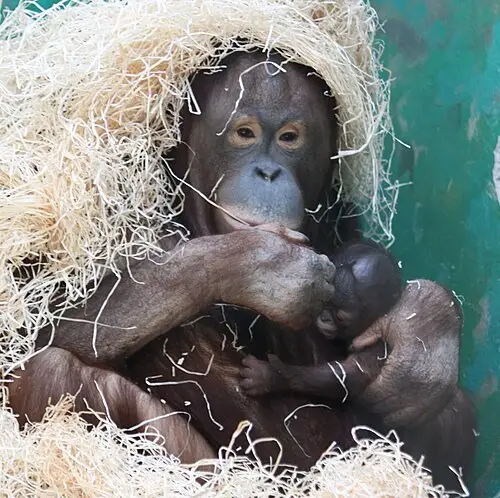
 📸 Photo
Photo: user mt7 · CC BY 3.0 · Wikimedia Commons Source
Bornean Orangutan
Pongo pygmaeus (Bornean Orangutan · ボルネオオランウータン)
💡 Everyday Comparisons for Size, Mass & Speed
- 💡 A male's average weight of 87 kg is about four and a half 20 kg bags of rice (Comparison).
- 💡 By eating over 500 plant species and dispersing their seeds, it keeps forests healthy, and ecotourism to see this orangutan provides important income for conservation groups (Animal Diversity Web).
Reference standards: coach bus ~12 m, mid-size car ~4.9 m, compact car ~1 t, basketball hoop 3.05 m, credit card 8.56 cm.
Site-computed relative index from recorded values; not a formal scientific metric.
📖 1. Overview
The Bornean Orangutan is an arboreal primate with orange-red hair and long arms that moves through the forest canopy following fruiting trees.
🦴 2. Anatomy & Morphology
It grasps branches with both hands and feet, and both sexes have throat pouches used for making calls. Males develop large cheek pads and a sagittal crest, and mature males occur in two forms: flanged and unflanged.
🔍 3. Ecology & Behavior
Fruit makes up more than 60% of its diet, and it eats over 500 plant species as well as insects, bird eggs, and fungi. It travels according to where fruit is available and rarely comes down from the trees.
🇰🇷 4. Connection to Korea
No direct record connecting this species to Korea has been found.
📚 Sources & References
- • IUCN Red List CR (2024) — https://www.iucnredlist.org/species/17975/259043172
- • IUCN Red List category CR — latest assessment at iucnredlist.org
- • mammaldiversity.org — 1000722
- • iucnredlist.org — 259043172
- • wikidata.org — Q599672
- • commons.wikimedia.org — File:Nanga with male baby.jpg
- • animaldiversity.org — Pongo pygmaeus
- • Silhouette: PhyloPic — Gareth Monger · CC BY 3.0
Recorded dimensions are widely cited representative estimates from public literature and may vary by study or specimen.