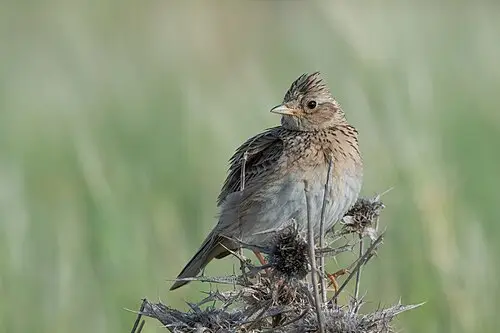
 📸 Photo
Photo: El Golli Mohamed · CC BY-SA 4.0 · Wikimedia Commons Source
Eurasian Skylark
Alauda arvensis (Eurasian Skylark · ヒバリ)
💡 Everyday Comparisons for Size, Mass & Speed
- 💡 It nests in barley and wheat fields, and males sing most from February to July (months 2–7) while soaring high into the sky (National List of Species of Korea, ADW).
- 💡 By eating weed seeds and harmful insects, it is helpful to farming (ADW).
- 💡 Its body length of 19 cm is slightly shorter than the short side of a sheet of A4 paper (21 cm) (Comparison).
Reference standards: coach bus ~12 m, mid-size car ~4.9 m, compact car ~1 t, basketball hoop 3.05 m, credit card 8.56 cm.
Site-computed relative index from recorded values; not a formal scientific metric.
📖 1. Overview
The Eurasian Skylark is a brown bird that nests on the ground in open grasslands and barley fields and sings while soaring high into the sky.
🦴 2. Anatomy & Morphology
Its body is pale yellowish brown, its head and back are reddish brown, and its breast is streaked with black. Its crown feathers are short and rounded and can be raised into a small crest.
🔍 3. Ecology & Behavior
It forages on the ground for grass seeds, insects, and invertebrates such as earthworms, beetles, and spiders. Males sing all day long, sometimes warbling for 10–15 minutes while climbing high into the air. It builds a bowl-shaped nest in the grass and lays 3–6 eggs.
🇰🇷 4. Connection to Korea
According to the National List of Species of Korea, its domestic distribution is nationwide, and it is a common resident and winter visitor breeding in lowland farmlands and grasslands.
📚 Sources & References
- • IUCN Red List LC (2018) — https://www.iucnredlist.org/species/102998555/132039889
- • IUCN Red List category LC — latest assessment at iucnredlist.org
- • doi.org — avilist.v2026
- • iucnredlist.org — 132039889
- • 국가생물종목록(국립생물자원관) ktsn 120000155370 — https://species.nibr.go.kr/home/mainHome.do?cont_link=009&subMenu=009002&contCd=009002&ktsn=120000155370
- • wikidata.org — Q25961
- • commons.wikimedia.org — File:Alouette des champs Zaghouan001.jpg
- • animaldiversity.org — Alauda arvensis
- • species.nibr.go.kr — mainHome.do
- • Silhouette: PhyloPic — Pearson Scott Foresman · Public Domain Mark 1.0
Recorded dimensions are widely cited representative estimates from public literature and may vary by study or specimen.