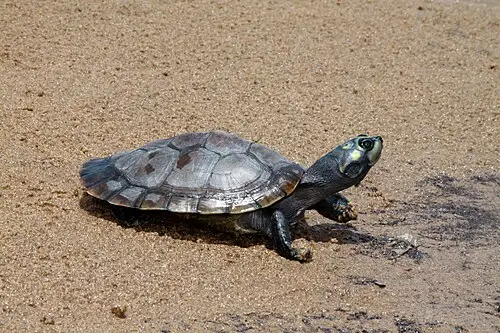
 📸 Photo
Photo: Luisovalles · CC BY-SA 3.0 · Wikimedia Commons Source
Arrau River Turtle
Podocnemis expansa (Arrau River Turtle · オオヨコクビガメ)
IUCN 의 옛 등급 «LR/cd(보전 의존)»으로 평가된 종입니다. 지금 기준으로는 준위협에 가깝습니다.
💡 Everyday Comparisons for Size, Mass & Speed
- 💡 A carapace length of over 80 cm is close to the length of a long umbrella (about 90 cm), and a maximum weight of 65 kg is just over three 20 kg bags of rice (Comparison).
- 💡 Overharvesting for its eggs, meat, and oil caused severe declines, and after the Brazilian government and others released thousands of hatchlings from protected nests, some populations stabilized (IUCN).
Reference standards: coach bus ~12 m, mid-size car ~4.9 m, compact car ~1 t, basketball hoop 3.05 m, credit card 8.56 cm.
Site-computed relative index from recorded values; not a formal scientific metric.
📖 1. Overview
The Arrau River Turtle is a large freshwater turtle living in major rivers of the Amazon and Orinoco basins. In the past, thousands of individuals swam upstream and gathered on high sandbars to lay eggs.
🦴 2. Anatomy & Morphology
Its hard, large carapace is dark gray to brown or olive, and males and females differ in size. Females and hatchlings make sounds underwater to communicate with each other.
🔍 3. Ecology & Behavior
Juveniles are omnivorous, eating stems, leaves, and invertebrates, whereas adults become herbivorous and disperse seeds. During the dry season when river levels drop, they gather in groups on exposed sandbars to nest, with up to 172 eggs recorded in a single clutch.
🇰🇷 4. Connection to Korea
No direct record connecting this species to Korea has been found.
📚 Sources & References
- • IUCN Red List category NT — latest assessment at iucnredlist.org
- • catalogueoflife.org — 4KQG8
- • iucnredlist.org — 17822
- • wikidata.org — Q2625714
- • commons.wikimedia.org — File:Tortuga-arrau.jpg
- • nc.iucnredlist.org — podocnemis-expansa.pdf
- • colombia.wcs.org — Giant-South-America-river-turtle.aspx
- • Silhouette: PhyloPic — Haplochromis · CC BY 4.0 (Congeneric silhouette — Podocnemis unifilis)
Recorded dimensions are widely cited representative estimates from public literature and may vary by study or specimen.