 📸 Photo
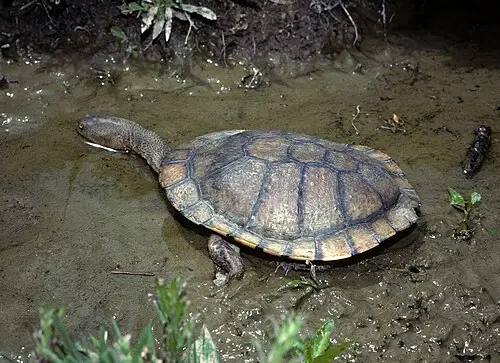
Photo: John Wombey, CSIRO · CC BY 3.0 · Wikimedia Commons Source
Common Snake-necked Turtle
Chelodina longicollis (Common Snake-necked Turtle · オーストラリアナガクビガメ)
Not Evaluated (NE) on the IUCN Red List yet.
💡 Everyday Comparisons for Size, Mass & Speed
- 💡 Its average length of 25 cm is slightly shorter than the long side of an A4 sheet (about 30 cm), and its average mass of 602 g is slightly heavier than a 500 mL bottle of water (Comparison).
- 💡 It has been hunted for meat by Indigenous Australians and is studied as an indicator species for wetland habitat health (benefit to humans noted by ADW).
Reference standards: coach bus ~12 m, mid-size car ~4.9 m, compact car ~1 t, basketball hoop 3.05 m, credit card 8.56 cm.
Site-computed relative index from recorded values; not a formal scientific metric.
📖 1. Overview
The Common Snake-necked Turtle is a semi-aquatic turtle living in swamps, wetlands, and slow streams of eastern Australia, characterized by its remarkably long neck. When conditions dry up, it travels long distances to find new water.
🦴 2. Anatomy & Morphology
Its carapace is black to light brown and oval with a shallow groove, while its long, narrow neck is about 60% of the plastron length and covered with tubercles. The head is small and pointed, and females are larger with deeper shells than males.
🔍 3. Ecology & Behavior
An ambush predator that eats aquatic invertebrates, fish, tadpoles, crustaceans, and carrion, it strikes out its long neck and opens its mouth to suck in prey. When water dries up, it can estivate underground for extended periods.
🇰🇷 4. Connection to Korea
No direct record connecting this species to Korea has been found.
📚 Sources & References
- • IUCN Red List: not evaluated (NE) — cross-checked with the Wikidata conservation-status entry
- • catalogueoflife.org — 5XQY4
- • wikidata.org — Q221080
- • commons.wikimedia.org — File:CSIRO ScienceImage 7775 Eastern Snakenecked Turtle.jpg
- • animaldiversity.org — Chelodina longicollis
- • Silhouette: PhyloPic — Andy Wilson · CC0 1.0
Recorded dimensions are widely cited representative estimates from public literature and may vary by study or specimen.