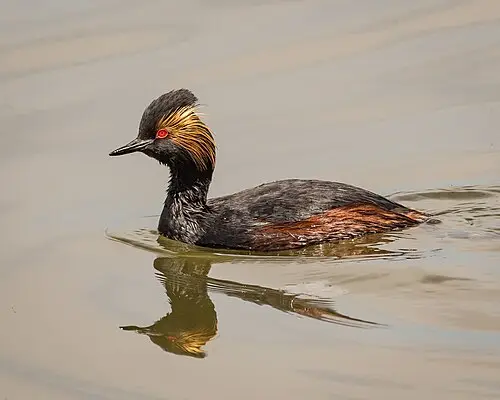
 📸 Photo
Photo: Becky Matsubara from El Sobrante, California · CC BY 2.0 · Wikimedia Commons Source
Black-necked Grebe
Podiceps nigricollis (Black-necked Grebe · ハジロカイツブリ)
💡 Everyday Comparisons for Size, Mass & Speed
- 💡 During migration and winter, huge flocks sometimes gather on lakes (Audubon).
- 💡 Its weight of about 306 g is slightly lighter than a beverage can (about 350 g) (Comparison).
Reference standards: coach bus ~12 m, mid-size car ~4.9 m, compact car ~1 t, basketball hoop 3.05 m, credit card 8.56 cm.
Site-computed relative index from recorded values; not a formal scientific metric.
📖 1. Overview
The Black-necked Grebe is a small grebe 31–38 cm in body length that floats and swims on the water and dives underwater to catch prey. It is the same species called the Eared Grebe in North America.
🦴 2. Anatomy & Morphology
It swims underwater by propelling itself with its feet, and like other grebes, it occasionally swallows its own feathers.
🔍 3. Ecology & Behavior
It eats insects, crustaceans, mollusks, tadpoles, and small fish, and at alkaline stopover lakes in autumn it often feeds mainly on brine shrimp. Pairs build floating nests of aquatic plants and breed in large colonies.
🇰🇷 4. Connection to Korea
It is listed under the name 'Geomeunmok-nonbyeongari' (Korean name) in the National List of Species of Korea.
📚 Sources & References
- • IUCN Red List LC (2018) — https://www.iucnredlist.org/species/22696610/132584321
- • IUCN Red List category LC — latest assessment at iucnredlist.org
- • doi.org — avilist.v2026
- • iucnredlist.org — 132584321
- • 국가생물종목록(국립생물자원관) ktsn 120000001506 — https://species.nibr.go.kr/home/mainHome.do?cont_link=009&subMenu=009002&contCd=009002&ktsn=120000001506
- • wikidata.org — Q185183
- • commons.wikimedia.org — File:Eared Grebe, breeding plumage (33774036404).jpg
- • audubon.org — eared-grebe
- • bto.org — black-necked-grebe
- • Silhouette: PhyloPic — Andy Wilson · CC0 1.0 (Congeneric silhouette — Podiceps auritus)
Recorded dimensions are widely cited representative estimates from public literature and may vary by study or specimen.