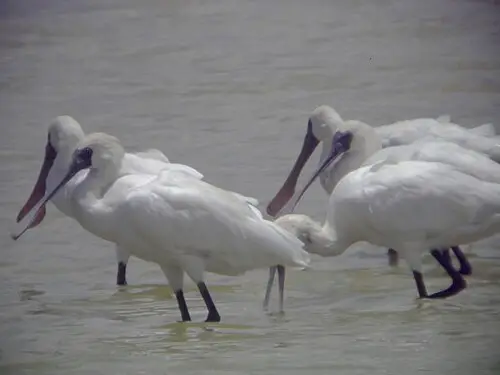
 📸 Photo
Photo: Charles Lam · CC BY-SA 2.0 · Wikimedia Commons Source
Black-faced Spoonbill
Platalea minor (Black-faced Spoonbill · クロツラヘラサギ)
🇰🇷 Class I endangered wildlife (Korea) · Natural Monument (Korea) «Black-faced Spoonbill»
💡 Everyday Comparisons for Size, Mass & Speed
- 💡 Its body length of about 78 cm is about 2.6 times the long side of an A4 sheet of paper (29.7 cm) (Comparison).
- 💡 Its body length of about 78 cm is slightly shorter than a baseball bat (about 84 cm) (Comparison).
- 💡 It has also been reported foraging in human-made waters such as fish farms.
Reference standards: coach bus ~12 m, mid-size car ~4.9 m, compact car ~1 t, basketball hoop 3.05 m, credit card 8.56 cm.
📖 1. Overview
The Black-faced Spoonbill breeds on small islands off the west coast of North and South Korea and Liaoning in China, and winters on tidal flats in Jeju, Japan, southern China, Taiwan, and northern Vietnam. It is listed as Vulnerable (VU) by the IUCN, and 5,222 birds were counted in the 2021 international census.
🦴 2. Anatomy & Morphology
It is a white waterbird 60–78 cm in body length with a long neck and legs, a large black spoon-shaped bill, and bare black facial skin. During the breeding season, its head and breast turn yellow and its head plumes lengthen.
🔍 3. Ecology & Behavior
It feeds on aquatic animals, mainly fish and shrimp, and occasionally crabs around 5 cm across. Its population fell to a few hundred in the 1990s before recovering in recent years.
🇰🇷 4. Connection to Korea
In Korea, it is Class I endangered wildlife (Korea) and was designated as a Natural Monument (Korea) on May 31, 1968. Its breeding grounds lie on small islands off the west coast of North and South Korea, and in winter it can also be seen in southern Korea and Jeju.
📚 Sources & References
- • IUCN Red List VU (2025) — https://www.iucnredlist.org/species/22697568/154689773
- • 멸종위기 야생생물 Ⅰ급 · 천연기념물 «저어새» — 국가생물종목록(국립생물자원관) ktsn 120000001519 — https://species.nibr.go.kr/home/mainHome.do?cont_link=009&subMenu=009002&contCd=009002&ktsn=120000001519
- • IUCN Red List category VU — latest assessment at iucnredlist.org
- • Korean protection status: Class I endangered wildlife (Korea) · Natural Monument (Korea) «Black-faced Spoonbill»
- • doi.org — avilist.v2026
- • iucnredlist.org — 154689773
- • 국가생물종목록(국립생물자원관) ktsn 120000001519 — https://species.nibr.go.kr/home/mainHome.do?cont_link=009&subMenu=009002&contCd=009002&ktsn=120000001519
- • heritage.go.kr — culSelectDetail.do
- • wikidata.org — Q494544
- • commons.wikimedia.org — File:Platalea minor.jpg
- • eaaflyway.org — black-faced-spoonbill
- • avifauna.hkbws.org.hk — 021900
- • Silhouette: PhyloPic — Andy Wilson · CC0 1.0 (Congeneric silhouette — Platalea ajaja)
Recorded dimensions are widely cited representative estimates from public literature and may vary by study or specimen.