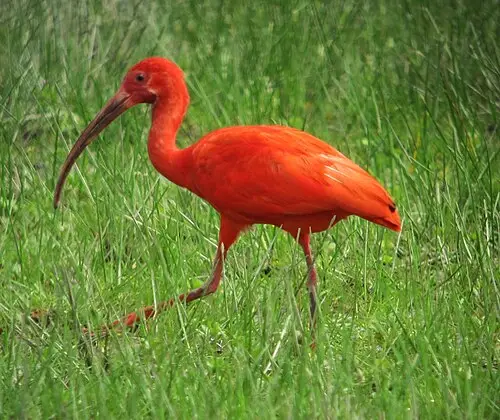
 📸 Photo
Photo: Félix Uribe from Rionegro, Antioquia, Colombia · CC BY-SA 2.0 · Wikimedia Commons Source
Scarlet Ibis
Eudocimus ruber (Scarlet Ibis · ショウジョウトキ)
💡 Everyday Comparisons for Size, Mass & Speed
- 💡 Its average weight of 615 g is slightly heavier than a 500 mL bottle of water (Comparison).
- 💡 In zoos, the red color of the Scarlet Ibis fades to pink, so it is given a special diet rich in protein and shrimp meat to maintain its color (Animal Diversity Web).
- 💡 Since the 16th century, Indigenous peoples have eaten its meat and eggs and used its vibrant feathers for adornment (Animal Diversity Web).
Reference standards: coach bus ~12 m, mid-size car ~4.9 m, compact car ~1 t, basketball hoop 3.05 m, credit card 8.56 cm.
Site-computed relative index from recorded values; not a formal scientific metric.
📖 1. Overview
The Scarlet Ibis is a South American ibis notable for its deep red plumage. It lives in mudflats, wetlands, and shallow bays, and is also rarely seen in Central America, the Caribbean, and southern Florida in the United States.
🦴 2. Anatomy & Morphology
Its entire body is red except for glossy blue-black wingtips, and it has a thin, down-curved bill, long legs, and slightly webbed feet. Juveniles have a grayish-brown body with a white belly.
🔍 3. Ecology & Behavior
It probes in water with its long bill or pecks at the ground to eat crayfish, small crabs, aquatic insects, frogs, and small fish. It flies in large flocks and builds nests close together to reduce the risk of predation.
🇰🇷 4. Connection to Korea
No direct record connecting this species to Korea has been found.
📚 Sources & References
- • IUCN Red List LC (2025) — https://www.iucnredlist.org/species/22697415/265008829
- • IUCN Red List category LC — latest assessment at iucnredlist.org
- • doi.org — avilist.v2026
- • iucnredlist.org — 265008829
- • wikidata.org — Q467996
- • commons.wikimedia.org — File:Eudocimus ruber Corocora Scarlet Ibis (6264848783).jpg
- • animaldiversity.org — Eudocimus ruber
- • nationalzoo.si.edu — scarlet-ibis
- • Silhouette: PhyloPic — Andy Wilson · CC0 1.0
Recorded dimensions are widely cited representative estimates from public literature and may vary by study or specimen.