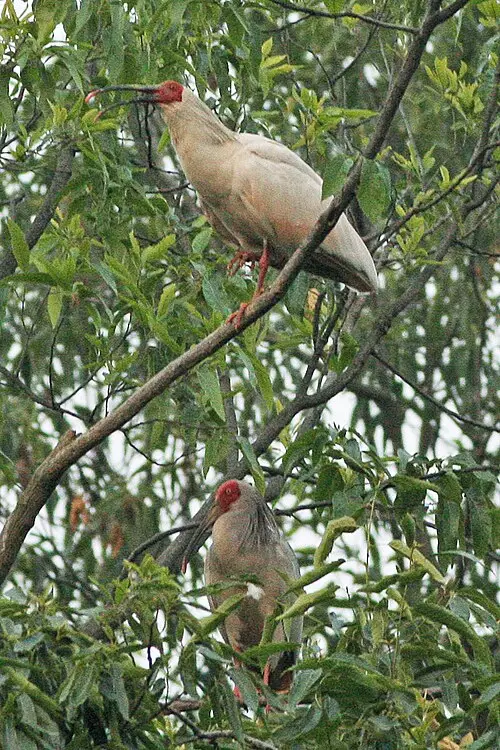
 📸 Photo
Photo: Ron Knight (sussexbirder) · CC BY 2.0 · Wikimedia Commons Source
Crested Ibis
Nipponia nippon (Crested Ibis · トキ)
🇰🇷 Class II endangered wildlife (Korea) · Natural Monument (Korea) «Crested Ibis»
💡 Everyday Comparisons for Size, Mass & Speed
- 💡 Its weight of about 1 kg is similar to a 1 L carton of milk (Comparison).
- 💡 Its wingspan of about 1.4 m is wider than a large open umbrella (about 1 m in diameter) (Comparison).
- 💡 Where wetlands are scarce, it uses rice paddies as feeding grounds.
Reference standards: coach bus ~12 m, mid-size car ~4.9 m, compact car ~1 t, basketball hoop 3.05 m, credit card 8.56 cm.
Site-computed relative index from recorded values; not a formal scientific metric.
📖 1. Overview
The Crested Ibis once lived from central China to Hokkaido in Japan and from southeastern Siberia to Taiwan, but now remains in only a few places in China. It is listed as Endangered (EN) by the IUCN.
🦴 2. Anatomy & Morphology
It weighs about 1 kg and has a wingspan of about 140 cm. Because Animal Diversity Web lists two different body lengths, 56 cm and 75 cm, a single body length is not given here.
🔍 3. Ecology & Behavior
It eats fish, frogs, salamanders, river crabs, crayfish, beetles, snails, and earthworms, foraging in mud covered by water shallower than its leg length (10–15 cm). It breeds from March to August and lays 1–5 eggs (an average of 3) per clutch.
🇰🇷 4. Connection to Korea
In Korea, it is Class II endangered wildlife (Korea) and was designated as a Natural Monument (Korea) on May 31, 1968. Animal Diversity Web notes that rice was also found in the stomach of a specimen obtained in Korea.
📚 Sources & References
- • IUCN Red List EN (2018) — https://www.iucnredlist.org/species/22697548/132069229
- • 멸종위기 야생생물 Ⅱ급 · 천연기념물 «따오기» — 국가생물종목록(국립생물자원관) ktsn 120000001516 — https://species.nibr.go.kr/home/mainHome.do?cont_link=009&subMenu=009002&contCd=009002&ktsn=120000001516
- • IUCN Red List category EN — latest assessment at iucnredlist.org
- • Korean protection status: Class II endangered wildlife (Korea) · Natural Monument (Korea) «Crested Ibis»
- • doi.org — avilist.v2026
- • iucnredlist.org — 132069229
- • 국가생물종목록(국립생물자원관) ktsn 120000001516 — https://species.nibr.go.kr/home/mainHome.do?cont_link=009&subMenu=009002&contCd=009002&ktsn=120000001516
- • heritage.go.kr — culSelectDetail.do
- • wikidata.org — Q493173
- • commons.wikimedia.org — File:Nipponia nippon, two, Yang Xian, Shaanxi, China.jpg
- • animaldiversity.org — Nipponia nippon
- • Silhouette: PhyloPic — An Ignorant Atheist · CC0 1.0 (Related taxon silhouette — Threskiornithidae)
Recorded dimensions are widely cited representative estimates from public literature and may vary by study or specimen.