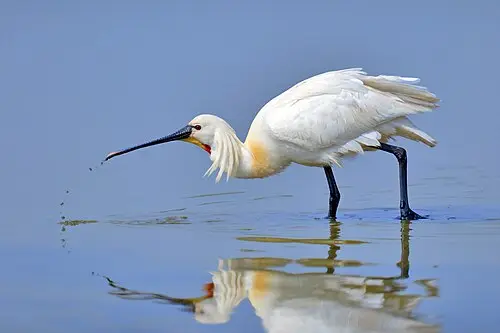
 📸 Photo
Photo: Andreas Trepte · CC BY-SA 2.5 · Wikimedia Commons Source
Eurasian Spoonbill
Platalea leucorodia (Eurasian Spoonbill · ヘラサギ)
🇰🇷 Class II endangered wildlife (Korea) · Natural Monument (Korea) «Eurasian Spoonbill»
💡 Everyday Comparisons for Size, Mass & Speed
- 💡 Its weight of about 1.5 kg is about one and a half 1 L cartons of milk (Comparison).
- 💡 Its body length of about 95 cm is similar to the length of an umbrella (about 90 cm) (Comparison).
Reference standards: coach bus ~12 m, mid-size car ~4.9 m, compact car ~1 t, basketball hoop 3.05 m, credit card 8.56 cm.
Site-computed relative index from recorded values; not a formal scientific metric.
📖 1. Overview
The Eurasian Spoonbill is a spoonbill that breeds from Europe to Kazakhstan, northern Mongolia, northeastern China, and Ussuri, and winters in Africa, India, western Myanmar, and southeastern China. It is listed as Least Concern (LC) by the IUCN.
🦴 2. Anatomy & Morphology
Its body length is 70–95 cm and its weight is about 1.5 kg.
🔍 3. Ecology & Behavior
It is a carnivore that eats mainly fish and shrimp, sweeping its bill from side to side in shallow water to strain out prey. In the United Kingdom, it usually lays 3–4 eggs and incubates them for 21–25 days.
🇰🇷 4. Connection to Korea
In Korea, it is Class II endangered wildlife (Korea) and was designated as a Natural Monument (Korea) on May 31, 1968. News from the East Asian–Australasian Flyway Partnership includes a record of 7 individuals observed on the Asan tidal flats in Chungcheongnam-do.
📚 Sources & References
- • IUCN Red List LC (2025) — https://www.iucnredlist.org/species/22697555/281857155
- • 멸종위기 야생생물 Ⅱ급 · 천연기념물 «노랑부리저어새» — 국가생물종목록(국립생물자원관) ktsn 120000001518 — https://species.nibr.go.kr/home/mainHome.do?cont_link=009&subMenu=009002&contCd=009002&ktsn=120000001518
- • IUCN Red List category LC — latest assessment at iucnredlist.org
- • Korean protection status: Class II endangered wildlife (Korea) · Natural Monument (Korea) «Eurasian Spoonbill»
- • doi.org — avilist.v2026
- • iucnredlist.org — 281857155
- • 국가생물종목록(국립생물자원관) ktsn 120000001518 — https://species.nibr.go.kr/home/mainHome.do?cont_link=009&subMenu=009002&contCd=009002&ktsn=120000001518
- • heritage.go.kr — culSelectDetail.do
- • wikidata.org — Q171360
- • commons.wikimedia.org — File:Eurasian Spoonbill.jpg
- • avifauna.hkbws.org.hk — 021800
- • bto.org — spoonbill
- • rspb.org.uk — spoonbill
- • eaaflyway.org — eurasian-spoonbill
- • Silhouette: PhyloPic — Jamie Whitehouse · CC0 1.0
Recorded dimensions are widely cited representative estimates from public literature and may vary by study or specimen.