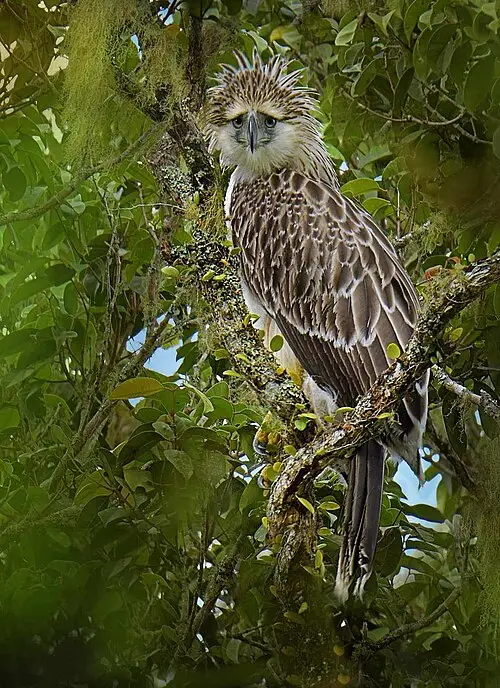
 📸 Photo
Photo: Aimee Valencia · CC BY 4.0 · Wikimedia Commons Source
Philippine Eagle
Pithecophaga jefferyi (Philippine Eagle · フィリピンワシ)
💡 Everyday Comparisons for Size, Mass & Speed
- 💡 Its average weight of 6.5 kg is slightly heavier than a bowling ball (about 6 kg) (Comparison).
- 💡 According to ADW, humans have hunted it for feathers and trophies, and a single pair uses an average territory of 100 km², about 1/6 the area of Seoul (about 605 km²).
Reference standards: coach bus ~12 m, mid-size car ~4.9 m, compact car ~1 t, basketball hoop 3.05 m, credit card 8.56 cm.
Site-computed relative index from recorded values; not a formal scientific metric.
📖 1. Overview
The Philippine Eagle is considered the largest eagle in the world and lives in the remaining primary forests of the Philippines. Because it preys on monkeys, it is also called the 'monkey-eating eagle.'
🦴 2. Anatomy & Morphology
Its belly and underwings are white, its upperparts are rich dark brown, and long feathers on the head and nape form a crest. Its legs are thick and yellow with large talons, and its bill is tall, deeply arched, and bluish-gray.
🔍 3. Ecology & Behavior
It feeds mainly on medium-sized mammals such as flying squirrels, palm civets, and monkeys, and also catches rats, snakes, small deer, birds, and bats. Pairs mate for life and occupy a territory of 60–130 km².
🇰🇷 4. Connection to Korea
No direct record connecting this species to Korea has been found.
📚 Sources & References
- • IUCN Red List CR (2025) — https://www.iucnredlist.org/species/22696012/273773083
- • IUCN Red List category CR — latest assessment at iucnredlist.org
- • doi.org — avilist.v2026
- • iucnredlist.org — 273773083
- • wikidata.org — Q185213
- • commons.wikimedia.org — File:Pamarayeg IIIx2.jpg
- • animaldiversity.org — Pithecophaga jefferyi
- • Silhouette: PhyloPic — Robert Cooke · CC0 1.0 (Related taxon silhouette — Accipitridae)
Recorded dimensions are widely cited representative estimates from public literature and may vary by study or specimen.