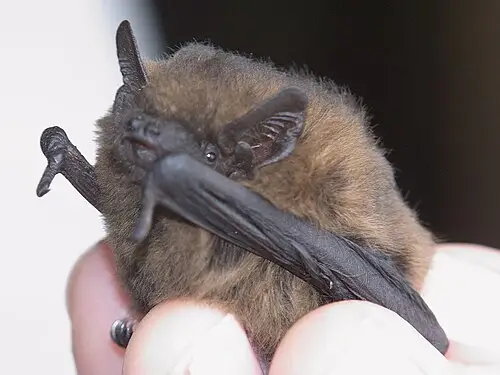
 📸 Photo
Photo: Drahkrub · CC BY-SA 4.0 · Wikimedia Commons Source
Common Pipistrelle
Pipistrellus pipistrellus (Common Pipistrelle · Common Pipistrelle)
💡 Everyday Comparisons for Size, Mass & Speed
- 💡 It also lives in city building crevices and parks, eating mosquitoes and helping control insect numbers.
- 💡 Its maximum weight of 8 g is almost the same as one Korean 500-won coin (about 7.7 g) (Comparison).
- 💡 Its maximum wingspan of 24 cm is slightly wider than the short side of an A4 sheet of paper (21 cm) (Comparison).
Reference standards: coach bus ~12 m, mid-size car ~4.9 m, compact car ~1 t, basketball hoop 3.05 m, credit card 8.56 cm.
Site-computed relative index from recorded values; not a formal scientific metric.
📖 1. Overview
The Common Pipistrelle is one of the smallest bats and is commonly seen in cities and towns across Europe.
🦴 2. Anatomy & Morphology
Its wingspan is 180–240 mm and its wings are narrow. The tragus is rounded at the top and quite long, the fur is usually brown, and the wing membranes are hairless dark brown.
🔍 3. Ecology & Behavior
Using echolocation, it flies along set paths over ponds and gardens to catch insects such as mosquitoes and small moths. It usually gives birth to twins from June to early July, and females can delay the timing of fertilization.
🇰🇷 4. Connection to Korea
No direct record connecting this species to Korea has been found.
📚 Sources & References
- • IUCN Red List LC (2020) — https://www.iucnredlist.org/species/85333513/196581936
- • IUCN Red List category LC — latest assessment at iucnredlist.org
- • mammaldiversity.org — 1005632
- • iucnredlist.org — 196581936
- • wikidata.org — Q176901
- • commons.wikimedia.org — File:Pipistrellus female-1.jpg
- • animaldiversity.org — Pipistrellus pipistrellus
- • Silhouette: PhyloPic — Margot Michaud · CC0 1.0
Recorded dimensions are widely cited representative estimates from public literature and may vary by study or specimen.