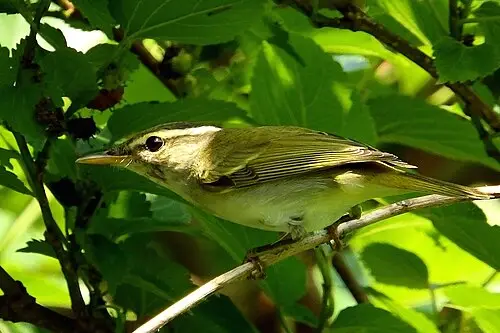
 📸 Photo
Photo: 孫鋒 林 · CC BY-SA 2.0 · Wikimedia Commons Source
Eastern Crowned Warbler
Phylloscopus coronatus (Eastern Crowned Warbler · センダイムシクイ)
💡 Everyday Comparisons for Size, Mass & Speed
- 💡 If you hear a rich, strong 'jji-it jji-it jji-i—' call in parks and low mountain woods in spring, it may be this bird (National List of Species of Korea).
- 💡 Its call is characterized by an opening part similar to the 'jjit-jjit-jjit' call of the Marsh Tit followed by a long drawn-out ending (National List of Species of Korea).
Reference standards: coach bus ~12 m, mid-size car ~4.9 m, compact car ~1 t, basketball hoop 3.05 m, credit card 8.56 cm.
📖 1. Overview
The Eastern Crowned Warbler is a small summer visitor living in lowland mountain deciduous broadleaf forests, breeding commonly in forests and parks across the Korean Peninsula.
🦴 2. Anatomy & Morphology
Its crown is dark brownish-olive, its upperparts are olive, and its underparts are dull white with a yellow center on the belly. A brownish median crown stripe from the forehead to the crown distinguishes it from other leaf warblers.
🔍 3. Ecology & Behavior
It lives alone or in pairs without forming flocks, and from April perches on tree branches calling 'jji-it jji-it jji-i—'. It builds a round nest of moss and bark under roots, on the ground, or in cliff hollows, laying 4–6 white eggs in May–June.
🇰🇷 4. Connection to Korea
According to the National List of Species of Korea, it is a summer visitor that commonly breeds in forests, woodlands, and parks throughout the Korean Peninsula.
📚 Sources & References
- • IUCN Red List LC (2024) — https://www.iucnredlist.org/species/22715348/264219341
- • IUCN Red List category LC — latest assessment at iucnredlist.org
- • doi.org — avilist.v2026
- • iucnredlist.org — 264219341
- • 국가생물종목록(국립생물자원관) ktsn 120000002053 — https://species.nibr.go.kr/home/mainHome.do?cont_link=009&subMenu=009002&contCd=009002&ktsn=120000002053
- • wikidata.org — Q2869566
- • commons.wikimedia.org — File:Eastern crowned warbler.jpg
- • species.nibr.go.kr — mainHome.do
- • Silhouette: PhyloPic — Jiekun He · CC0 1.0 (Congeneric silhouette — Phylloscopus)
Recorded dimensions are widely cited representative estimates from public literature and may vary by study or specimen.