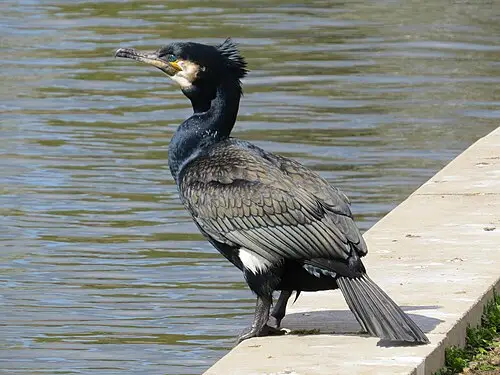
 📸 Photo
Photo: MPF · CC BY-SA 4.0 · Wikimedia Commons Source
Great Cormorant
Phalacrocorax carbo (Great Cormorant · カワウ)
💡 Everyday Comparisons for Size, Mass & Speed
- 💡 Its maximum weight of 3.7 kg is about 1/5 of a 20 kg bag of rice (Comparison).
- 💡 In China and Japan, cormorant fishing—placing a ring around the bird's neck to catch fish—has been practiced since around the 5th century and continues today (Animal Diversity Web).
- 💡 The black birds seen flying in lines over estuaries, rivers, and lakes in winter are this species (National List of Species of Korea).
Reference standards: coach bus ~12 m, mid-size car ~4.9 m, compact car ~1 t, basketball hoop 3.05 m, credit card 8.56 cm.
Site-computed relative index from recorded values; not a formal scientific metric.
📖 1. Overview
The Great Cormorant is a large waterbird with glossy black plumage overall, living widely across Eurasia, Africa, Australia, and North America. It dives to catch fish.
🦴 2. Anatomy & Morphology
Its body is black with a bluish gloss, and the base of the bill is yellow. During the breeding season, short white plumes grow on the head and neck, and white patches appear on the thighs.
🔍 3. Ecology & Behavior
It catches mainly fish up to 20 cm long, diving from the surface to the bottom in pursuit. In Korea, it flies in regular formations like geese when migrating.
🇰🇷 4. Connection to Korea
It is a very common winter visitor wintering along coasts, estuaries, rivers, and lakes, and a rare resident bird breeding in some inland areas.
📚 Sources & References
- • IUCN Red List LC (2019) — https://www.iucnredlist.org/species/22696792/155523636
- • IUCN Red List category LC — latest assessment at iucnredlist.org
- • doi.org — avilist.v2026
- • iucnredlist.org — 155523636
- • 국가생물종목록(국립생물자원관) ktsn 120000001565 — https://species.nibr.go.kr/home/mainHome.do?cont_link=009&subMenu=009002&contCd=009002&ktsn=120000001565
- • wikidata.org — Q25440
- • commons.wikimedia.org — File:2021-05-05 Phalacrocorax carbo carbo, Killingworth Lake
- • animaldiversity.org — Phalacrocorax carbo
- • species.nibr.go.kr — mainHome.do
- • Silhouette: PhyloPic — Ferran Sayol · CC0 1.0
Recorded dimensions are widely cited representative estimates from public literature and may vary by study or specimen.