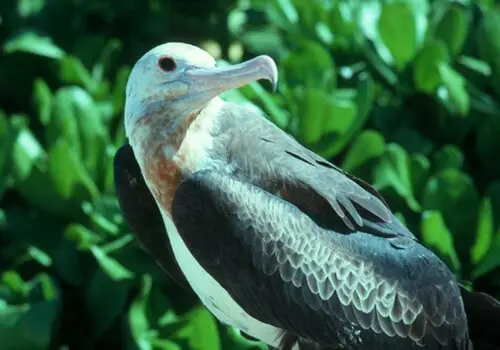
 📸 Photo
Photo: Public domain · Public domain · Wikimedia Commons Source
Great Frigatebird
Fregata minor (Great Frigatebird · オオグンカンドリ)
💡 Everyday Comparisons for Size, Mass & Speed
- 💡 Its wingspan of about 2.3 m is wider than the width of a passenger car (about 1.8 m) (Comparison).
- 💡 Its weight of about 1.8 kg is slightly less than two 1 L cartons of milk (about 1 kg each) (Comparison).
Reference standards: coach bus ~12 m, mid-size car ~4.9 m, compact car ~1 t, basketball hoop 3.05 m, credit card 8.56 cm.
Site-computed relative index from recorded values; not a formal scientific metric.
📖 1. Overview
The Great Frigatebird is a seabird found across tropical oceans, nesting on remote islands in the tropical Pacific, western Atlantic, and southern Indian Ocean. It is listed as Least Concern (LC) by the IUCN.
🦴 2. Anatomy & Morphology
Its body length is 85–105 cm and its weight is 1–1.8 kg, while its wingspan is 205–230 cm, making its wings very long relative to its body.
🔍 3. Ecology & Behavior
It snatches flying fish and squid within 15 cm of the water surface and also steals prey caught by boobies or tropicbirds. It can soar for hours without flapping its wings and almost never lands on the ground or water.
🇰🇷 4. Connection to Korea
No direct record connecting this species to Korea has been found.
📚 Sources & References
- • IUCN Red List LC (2020) — https://www.iucnredlist.org/species/22697733/163770613
- • IUCN Red List category LC — latest assessment at iucnredlist.org
- • doi.org — avilist.v2026
- • iucnredlist.org — 163770613
- • 국가생물종목록(국립생물자원관) ktsn 120000001552 — https://species.nibr.go.kr/home/mainHome.do?cont_link=009&subMenu=009002&contCd=009002&ktsn=120000001552
- • wikidata.org — Q648494
- • commons.wikimedia.org — File:NPSgreaterfrigatebird.jpg
- • animaldiversity.org — Fregata minor
- • Silhouette: PhyloPic — Thea Boodhoo (photograph) and T. Michael Keesey (vectorization) · CC BY 3.0 (Congeneric silhouette — Fregata)
Recorded dimensions are widely cited representative estimates from public literature and may vary by study or specimen.