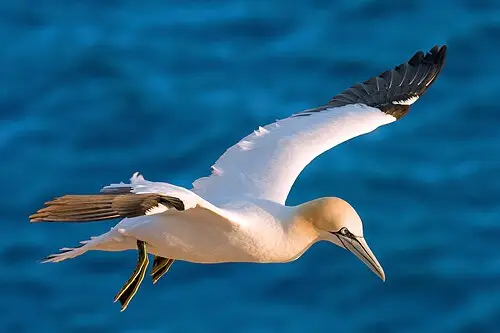
 📸 Photo
Photo: Andreas Trepte · CC BY-SA 2.5 · Wikimedia Commons Source
Northern Gannet
Morus bassanus (Northern Gannet · シロカツオドリ)
💡 Everyday Comparisons for Size, Mass & Speed
- 💡 Its maximum weight of 3.61 kg is less than 1/5 of a 20 kg bag of rice (Comparison).
- 💡 Its flight speed of over 60 km per hour is close to the speed limit on city roads (Comparison).
- 💡 Monitoring what this bird eats is also used to estimate the abundance and distribution of prey fish such as salmon (Animal Diversity Web).
Reference standards: coach bus ~12 m, mid-size car ~4.9 m, compact car ~1 t, basketball hoop 3.05 m, credit card 8.56 cm.
Site-computed relative index from recorded values; not a formal scientific metric.
📖 1. Overview
The Northern Gannet is the largest seabird in the North Atlantic, with a white body and black wingtips. It spends most of the year at sea and gathers densely on cliffs to breed in summer.
🦴 2. Anatomy & Morphology
The head and nape are yellowish, the bill is pale blue with black serrations on the lower mandible, and the legs and feet are gray-black.
🔍 3. Ecology & Behavior
It feeds on schools of fish and squid near the surface, usually catching prey down to about 15 m deep. Pairs bond for life and fight fiercely by locking bills over nesting sites.
🇰🇷 4. Connection to Korea
No direct record connecting this species to Korea has been found.
📚 Sources & References
- • IUCN Red List LC (2018) — https://www.iucnredlist.org/species/22696657/132587285
- • IUCN Red List category LC — latest assessment at iucnredlist.org
- • doi.org — avilist.v2026
- • iucnredlist.org — 132587285
- • wikidata.org — Q26675
- • commons.wikimedia.org — File:Morus bassanus adu.jpg
- • animaldiversity.org — Morus bassanus
- • Silhouette: PhyloPic — author not recorded · CC0 1.0
Recorded dimensions are widely cited representative estimates from public literature and may vary by study or specimen.