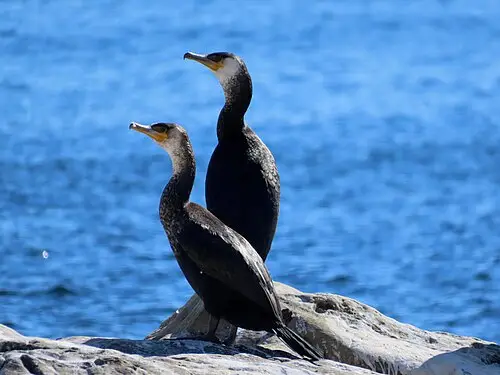
 📸 Photo
Photo: belvedere04 · CC BY 4.0 · Wikimedia Commons Source
Japanese Cormorant
Phalacrocorax capillatus (Japanese Cormorant · ウミウ)
💡 Everyday Comparisons for Size, Mass & Speed
- 💡 Its body length of about 84 cm is similar to the length of a long umbrella (about 80–90 cm) (Comparison).
- 💡 When touring islands such as Ulleungdo by boat, the black bird seen spreading its wings to dry on rocky cliffs is this species (National List of Species of Korea).
- 💡 Unlike the Great Cormorant, it can be distinguished by the wide white patch behind the eye with an angled border (National List of Species of Korea).
Reference standards: coach bus ~12 m, mid-size car ~4.9 m, compact car ~1 t, basketball hoop 3.05 m, credit card 8.56 cm.
📖 1. Overview
The Japanese Cormorant is a seabird that breeds locally in the Russian Far East, Sakhalin, northern Kyushu in Japan, Korea, and the Yellow Sea region of China. It breeds in colonies on islands and coastal cliffs.
🦴 2. Anatomy & Morphology
Its upperparts are greenish-black with a metallic gloss, and its tail is short. The yellow area at the base of the bill is narrower than in the Great Cormorant, and the white area behind the eye is wide with an angled border.
🔍 3. Ecology & Behavior
It dives to catch prey and climbs onto rocks out of the water to spread its wings and dry them in the sun. It builds a saucer-shaped nest of dried grass and seaweed in hollows on rock cliffs and lays 4–5 eggs from late May to July.
🇰🇷 4. Connection to Korea
It is a rare resident bird breeding on rocky cliffs of islands off the western and southern coasts as well as Ulleungdo.
📚 Sources & References
- • IUCN Red List LC (2018) — https://www.iucnredlist.org/species/22696799/132594150
- • IUCN Red List category LC — latest assessment at iucnredlist.org
- • doi.org — avilist.v2026
- • iucnredlist.org — 132594150
- • 국가생물종목록(국립생물자원관) ktsn 120000001566 — https://species.nibr.go.kr/home/mainHome.do?cont_link=009&subMenu=009002&contCd=009002&ktsn=120000001566
- • wikidata.org — Q727214
- • commons.wikimedia.org — File:Phalacrocorax capillatus from iNaturalist photo 4663164
- • species.nibr.go.kr — mainHome.do
- • Silhouette: PhyloPic — Ferran Sayol · CC0 1.0 (Congeneric silhouette — Phalacrocorax carbo)
Recorded dimensions are widely cited representative estimates from public literature and may vary by study or specimen.