 📸 Photo
Photo: Fernando Losada Rodríguez · CC BY-SA 4.0 · Wikimedia Commons Source
Sea lamprey
Petromyzon marinus (Sea lamprey · ウミヤツメ)
💡 Everyday Comparisons for Size, Mass & Speed
- 💡 Its maximum length of 1.2 m is 20 cm longer than a 1 m ruler (Comparison).
- 💡 Its maximum weight of 2.5 kg is about 1/8 of a 20 kg bag of rice (Comparison).
- 💡 According to Animal Diversity Web, it is eaten as a delicacy in many foreign regions including parts of Asia and India.
Reference standards: coach bus ~12 m, mid-size car ~4.9 m, compact car ~1 t, basketball hoop 3.05 m, credit card 8.56 cm.
Site-computed relative index from recorded values; not a formal scientific metric.
📖 1. Overview
The sea lamprey is the largest and most aggressive lamprey living along both coasts of the North Atlantic, growing in the sea and spawning in rivers. Some landlocked populations live permanently in freshwater lakes such as the Great Lakes.
🦴 2. Anatomy & Morphology
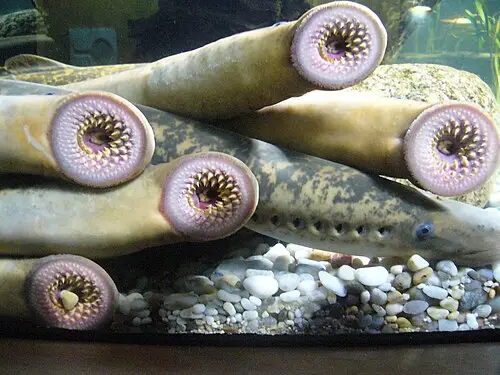
It lacks jaws and has an entirely cartilaginous skeleton, with a smooth, scaleless, elongated cylindrical body that is sometimes mistaken for an eel. It has 7 gill openings behind each eye, and its oval attachment mouth opens wider than its head.
🔍 3. Ecology & Behavior
Newly hatched larvae filter-feed on organic matter and algae in river bottoms before migrating to the sea (or the Great Lakes), where they live parasitically by attaching to fish and feeding on their blood and flesh. From April to June, a female lays 30,000–100,000 eggs, and adults stop feeding around spawning time.
🇰🇷 4. Connection to Korea
No direct record connecting this species to Korea has been found.
📚 Sources & References
- • IUCN Red List LC (2024) — https://www.iucnredlist.org/species/16781/58298056
- • IUCN Red List category LC — latest assessment at iucnredlist.org
- • catalogueoflife.org — 6V6DZ
- • iucnredlist.org — 58298056
- • wikidata.org — Q385764
- • commons.wikimedia.org — File:Petromyzon marinus.001 - Aquarium Finisterrae.jpg
- • fishbase.se — Petromyzon-marinus.html
- • animaldiversity.org — Petromyzon marinus
- • Silhouette: PhyloPic — Arcadia Science · CC0 1.0
Recorded dimensions are widely cited representative estimates from public literature and may vary by study or specimen.