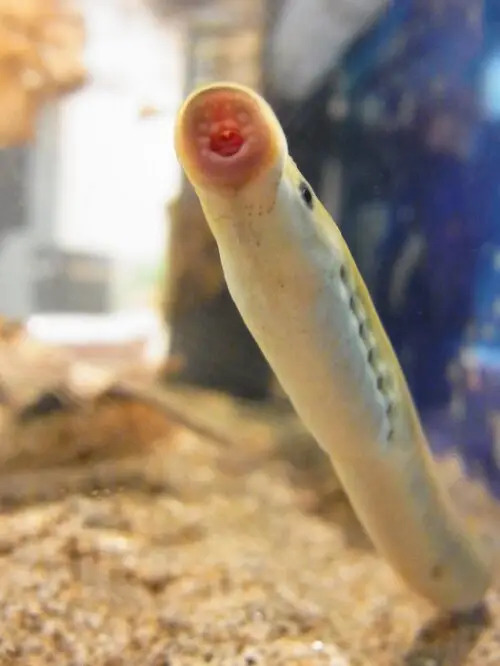
 📸 Photo
Photo: Loki austanfell · CC BY-SA 3.0 · Wikimedia Commons Source
Far Eastern brook lamprey
Lethenteron reissneri (Far Eastern brook lamprey · シベリアヤツメ)
🇰🇷 Class II endangered wildlife (Korea)
💡 Everyday Comparisons for Size, Mass & Speed
- 💡 Its body length of 26 cm is about 5 cm longer than the short side of an A4 sheet of paper (21 cm) (Comparison).
- 💡 The National Institute of Ecology explains that larvae lose their habitat when sandy and gravelly bottoms disappear due to river maintenance and construction.
- 💡 The National Institute of Ecology notes that the congeneric Arctic lamprey declined sharply due to indiscriminate harvesting for medicinal use.
Reference standards: coach bus ~12 m, mid-size car ~4.9 m, compact car ~1 t, basketball hoop 3.05 m, credit card 8.56 cm.
📖 1. Overview
The Far Eastern brook lamprey is a jawless lamprey with a slender, eel-like body that spends its entire life in freshwater. It is a Class II endangered wildlife (Korea) species and is listed as Least Concern (LC, 2024) on the IUCN Red List.
🦴 2. Anatomy & Morphology
It has 7 pairs of gill openings behind the eyes, and its mouth is a round sucking disc without jaws. It lacks pectoral and pelvic fins and has a few dark spots on the caudal fin.
🔍 3. Ecology & Behavior
Larvae filter-feed on organic matter in sandy river bottoms for over 3 years before becoming adults in the autumn or winter of their 4th year, after which adults do not eat at all. In March–April, they dig pits in sandy and gravelly bottoms, spawn, and die.
🇰🇷 4. Connection to Korea
It once lived in rivers and reservoirs throughout Korea except Jeju Island, but is now a Class II endangered wildlife (Korea) species whose numbers are declining due to habitat damage from pollution and river construction.
📚 Sources & References
- • IUCN Red List LC (2024) — https://www.iucnredlist.org/species/135609/135108335
- • 멸종위기 야생생물 Ⅱ급 — 국가생물종목록(국립생물자원관) ktsn 120000057234 — https://species.nibr.go.kr/home/mainHome.do?cont_link=009&subMenu=009002&contCd=009002&ktsn=120000057234
- • IUCN Red List category LC — latest assessment at iucnredlist.org
- • Korean protection status: Class II endangered wildlife (Korea)
- • catalogueoflife.org — 722LG
- • iucnredlist.org — 135108335
- • 국가생물종목록(국립생물자원관) ktsn 120000057234 — https://species.nibr.go.kr/home/mainHome.do?cont_link=009&subMenu=009002&contCd=009002&ktsn=120000057234
- • wikidata.org — Q5034621
- • commons.wikimedia.org — File:Eastern-brook-lamprey L reissneri-02.jpg
- • fishbase.se — Lethenteron-reissneri.html
- • nie.re.kr — view.do
- • nie.re.kr — view.do
- • species.nibr.go.kr — mainHome.do
- • Silhouette: PhyloPic — Arcadia Science · CC0 1.0 (Related taxon silhouette — Petromyzon marinus)
Recorded dimensions are widely cited representative estimates from public literature and may vary by study or specimen.