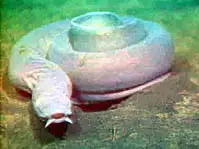
 📸 Photo
Photo: Lmozero · Public domain · Wikimedia Commons Source
Pacific hagfish
Eptatretus stoutii (Pacific hagfish · Pacific hagfish)
💡 Everyday Comparisons for Size, Mass & Speed
- 💡 Its body weight of 1.4 kg is similar to the weight of a single 1.5 L plastic bottle (Comparison).
- 💡 According to the U.S. Animal Diversity Web, about 5 million pounds (about 2,300 tons) of Pacific hagfish meat are consumed yearly in Korea, and in many parts of the world its skin is used for eelskin products such as wallets and shoes.
- 💡 It can be seen in public aquariums and is studied as a research subject because of its very slow metabolism (Animal Diversity Web, FishBase).
Reference standards: coach bus ~12 m, mid-size car ~4.9 m, compact car ~1 t, basketball hoop 3.05 m, credit card 8.56 cm.
Site-computed relative index from recorded values; not a formal scientific metric.
📖 1. Overview
The Pacific hagfish is a hagfish living on the eastern Pacific sea floor from southeastern Alaska to Baja California in Mexico. It is famous for producing slime and tying its own body into knots.
🦴 2. Anatomy & Morphology
Its body is long, cylindrical, and pinkish gray. Instead of jaws, it has two pairs of tooth-like rough rasps on its tongue; its eyes are small and degenerate, and it senses smell and touch with short tentacles around its mouth. Slime glands are lined up along the sides of its body.
🔍 3. Ecology & Behavior
It feeds on dead or dying fishes, mammals, and marine invertebrates, tying its body into a knot to gain leverage for tearing off flesh. When its slime touches seawater, it instantly turns into a sticky gel that can suffocate attackers. It lays 20–30 eggs at a time.
🇰🇷 4. Connection to Korea
No direct record connecting this species to Korea has been found.
📚 Sources & References
- • IUCN Red List DD (2011) — https://www.iucnredlist.org/species/196044/8997397
- • IUCN Red List category DD — latest assessment at iucnredlist.org
- • catalogueoflife.org — 6FZ3N
- • iucnredlist.org — 8997397
- • wikidata.org — Q683492
- • commons.wikimedia.org — File:Pacific hagfish Myxine.jpg
- • animaldiversity.org — Eptatretus stoutii
- • fishbase.se — Eptatretus-stoutii.html
- • Silhouette: PhyloPic — author not recorded · CC0 1.0
Recorded dimensions are widely cited representative estimates from public literature and may vary by study or specimen.