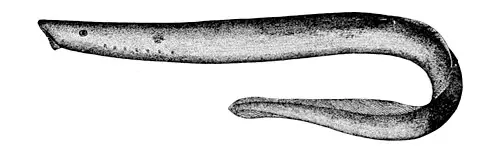
 📸 Photo
Photo: Anonymous Unknown author · Public domain · Wikimedia Commons Source
Arctic lamprey
Lethenteron camtschaticum (Arctic lamprey · Arctic lamprey)
🇰🇷 Class II endangered wildlife (Korea)
💡 Everyday Comparisons for Size, Mass & Speed
- 💡 Its body length of 40–50 cm recorded by the National Institute of Ecology is about 1.4–1.7 times the long side of an A4 sheet of paper (29.7 cm) (Comparison).
- 💡 Its maximum weight of 200 g is about the weight of four eggs (Comparison, counting 1 egg as about 50 g).
- 💡 It is confirmed only in streams flowing into the East Sea such as Yangyang Namdaecheon and Yeongokcheon in Gangwon-do, and overharvesting for medicinal use was one cause of its sharp decline (National Institute of Ecology).
Reference standards: coach bus ~12 m, mid-size car ~4.9 m, compact car ~1 t, basketball hoop 3.05 m, credit card 8.56 cm.
Site-computed relative index from recorded values; not a formal scientific metric.
📖 1. Overview
The Arctic lamprey is a long, eel-like jawless fish that grows in the sea, ascends rivers to spawn, and then dies. Its Korean name comes from the 7 pairs of gill openings behind its eyes.
🦴 2. Anatomy & Morphology
Its mouth is a jawless sucking disc with teeth, and it lacks paired fins and scales. The nostril sits on top of the head and is not connected to the mouth. The upper side of the body is grayish-brown and the underside is paler.
🔍 3. Ecology & Behavior
Adults live in the sea for 2–3 years sucking the blood of other fish, then ascend rivers in May–June to spawn on sandy and gravelly bottoms before dying. Larvae live in river mud for about 4 years, filter-feeding on organic matter at night.
🇰🇷 4. Connection to Korea
It is a Class II endangered wildlife (Korea) species. In the past it lived widely in rivers flowing into the East Sea and South Sea, but today it is confirmed only in Baebongcheon, Yangyang Namdaecheon, and Yeongokcheon Streams flowing into the East Sea. Its numbers have dropped sharply due to pollution, river construction, and overharvesting for medicinal use.
📚 Sources & References
- • IUCN Red List LC (2024) — https://www.iucnredlist.org/species/135719/135112743
- • 멸종위기 야생생물 Ⅱ급 — 국가생물종목록(국립생물자원관) ktsn 120000057232 — https://species.nibr.go.kr/home/mainHome.do?cont_link=009&subMenu=009002&contCd=009002&ktsn=120000057232
- • IUCN Red List category LC — latest assessment at iucnredlist.org
- • Korean protection status: Class II endangered wildlife (Korea)
- • catalogueoflife.org — 6Q2LL
- • iucnredlist.org — 135112743
- • 국가생물종목록(국립생물자원관) ktsn 120000057232 — https://species.nibr.go.kr/home/mainHome.do?cont_link=009&subMenu=009002&contCd=009002&ktsn=120000057232
- • wikidata.org — Q178729
- • commons.wikimedia.org — File:Lampetra camtschatica.jpg
- • fishbase.se — Lethenteron-camtschaticum.html
- • species.nibr.go.kr — mainHome.do
- • nie.re.kr — view.do
- • Silhouette: PhyloPic — Arcadia Science · CC0 1.0 (Related taxon silhouette — Petromyzon marinus)
Recorded dimensions are widely cited representative estimates from public literature and may vary by study or specimen.