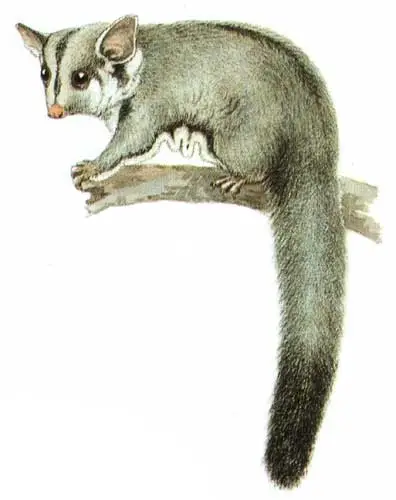
 📸 Photo
Photo: Public domain · Public domain · Wikimedia Commons Source
Sugar Glider
Petaurus breviceps (Sugar Glider · フクロモモンガ)
💡 Everyday Comparisons for Size, Mass & Speed
- 💡 Its average weight of 110 g is similar to two eggs (about 120 g), and its maximum single glide of 45 m is nearly half the length of a soccer field (about 100 m) (Comparison).
- 💡 Its numbers have grown in the United States due to recent popularity as a pet, and regulations and USDA guidelines for keeping them vary from state to state.
Reference standards: coach bus ~12 m, mid-size car ~4.9 m, compact car ~1 t, basketball hoop 3.05 m, credit card 8.56 cm.
Site-computed relative index from recorded values; not a formal scientific metric.
📖 1. Overview
The Sugar Glider is a small gliding marsupial native to Australia that builds its nests in the branches of eucalyptus trees in forests.
🦴 2. Anatomy & Morphology
It has a blue-grey body with a dark dorsal stripe running up to its nose and stripes on each side of the face from eye to ear. A gliding membrane extends from the outer forefoot to the ankle of the hind foot, and females have a well-developed pouch.
🔍 3. Ecology & Behavior
It can glide up to 45 m in a single leap. In spring and summer it feeds mainly on insects such as moths and beetles, while in autumn and winter it eats plant foods such as eucalyptus sap and pollen. Related groups of up to 7 individuals defend a territory.
🇰🇷 4. Connection to Korea
No direct record connecting this species to Korea has been found.
📚 Sources & References
- • IUCN Red List LC (2016) — https://www.iucnredlist.org/species/16731/21959798
- • IUCN Red List category LC — latest assessment at iucnredlist.org
- • mammaldiversity.org — 1000344
- • iucnredlist.org — 21959798
- • wikidata.org — Q723435
- • commons.wikimedia.org — File:Petaurus breviceps-Cayley.jpg
- • animaldiversity.org — Petaurus breviceps
- • Silhouette: PhyloPic — Margot Michaud · CC0 1.0
Recorded dimensions are widely cited representative estimates from public literature and may vary by study or specimen.