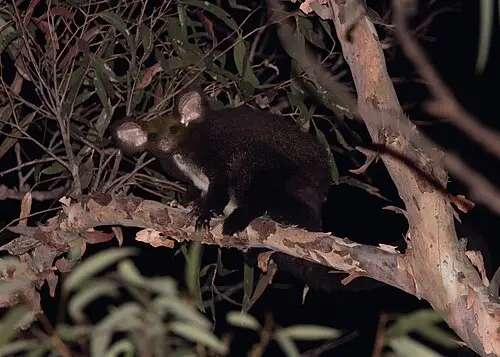
 📸 Photo
Photo: Mark Gillow · CC BY 2.0 · Wikimedia Commons Source
Southern Greater Glider
Petauroides volans (Southern Greater Glider · フクロムササビ)
💡 Everyday Comparisons for Size, Mass & Speed
- 💡 Its weight of 1–1.5 kg is about that of a domestic cat, and 1.5 kg is similar to a 1.5 L bottle of water (Comparison). A tail of about 50 cm is added to a head-and-body length of up to 48 cm.
- 💡 Because of its highly specialized diet, it is notoriously difficult to keep in zoos. Its fur is long and thick but soft and hard to work with, so fur traders rarely sought it.
Reference standards: coach bus ~12 m, mid-size car ~4.9 m, compact car ~1 t, basketball hoop 3.05 m, credit card 8.56 cm.
Site-computed relative index from recorded values; not a formal scientific metric.
📖 1. Overview
The Southern Greater Glider is the largest of the gliding possums, living in tall eucalyptus forests of Australia. It is assessed as Endangered (EN) on the IUCN Red List.
🦴 2. Anatomy & Morphology
About the size of a domestic cat, it has a short snout and large round ears covered with fur. A furred gliding membrane stretching from the knee to the elbow gives it a triangular shape in flight, and its long bushy tail acts as a rudder.
🔍 3. Ecology & Behavior
It feeds almost exclusively on eucalyptus leaves, digesting them through bacterial fermentation in an enlarged cecum, and rarely drinks water. It nests alone in tree hollows and is clumsy on the ground but agile in trees and in the air.
🇰🇷 4. Connection to Korea
No direct record connecting this species to Korea has been found.
📚 Sources & References
- • IUCN Red List EN (2025) — https://www.iucnredlist.org/species/40579/217036853
- • IUCN Red List category EN — latest assessment at iucnredlist.org
- • mammaldiversity.org — 1000351
- • iucnredlist.org — 217036853
- • wikidata.org — Q668004
- • commons.wikimedia.org — File:Greater Glider - 49098498141.jpg
- • animaldiversity.org — Petauroides volans
- • Silhouette: PhyloPic — Rachel T Mason · CC0 1.0
Recorded dimensions are widely cited representative estimates from public literature and may vary by study or specimen.