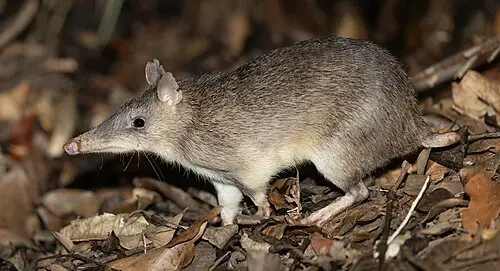
 📸 Photo
Photo: JJ Harrison ( https://www.jjharrison.com.au/ ) · CC BY-SA 4.0 · Wikimedia Commons Source
Long-nosed Bandicoot
Perameles nasuta (Long-nosed Bandicoot · ハナナガバンディクート)
💡 Everyday Comparisons for Size, Mass & Speed
- 💡 Its maximum weight of 897 g is slightly lighter than a 1 L carton of milk (about 1 kg), and its average total length of 50.8 cm is about 1.7 times the long side of A4 paper (Comparison).
- 💡 Studies in Sydney Harbour National Park have examined its diet, and its heavy consumption of insects may help reduce pest populations.
Reference standards: coach bus ~12 m, mid-size car ~4.9 m, compact car ~1 t, basketball hoop 3.05 m, credit card 8.56 cm.
Site-computed relative index from recorded values; not a formal scientific metric.
📖 1. Overview
The Long-nosed Bandicoot is a marsupial native to eastern Australia that lives across a wide range of environments from open areas to forests, swamps, cities, and suburbs.
🦴 2. Anatomy & Morphology
It has reddish-brown to sandy fur with a white to cream belly. Its snout is long with a noticeably cleft upper lip, and its hind legs are longer than its front legs. Its pouch opens to the rear and contains 8 nipples.
🔍 3. Ecology & Behavior
At night it forages for invertebrates, small vertebrates, plant roots, and fungi, and rests in burrows during the day. It is mostly solitary, and females give birth to an average of 4 litters per year.
🇰🇷 4. Connection to Korea
No direct record connecting this species to Korea has been found.
📚 Sources & References
- • IUCN Red List LC (2016) — https://www.iucnredlist.org/species/40554/115173969
- • IUCN Red List category LC — latest assessment at iucnredlist.org
- • mammaldiversity.org — 1000243
- • iucnredlist.org — 115173969
- • wikidata.org — Q194268
- • commons.wikimedia.org — File:A13I6091.jpg
- • animaldiversity.org — Perameles nasuta
- • Silhouette: PhyloPic — Steven Traver · CC0 1.0
Recorded dimensions are widely cited representative estimates from public literature and may vary by study or specimen.