 📸 Photo
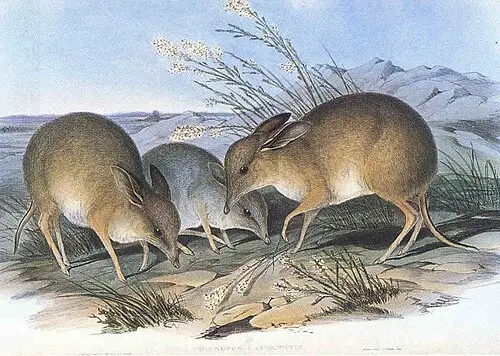
Photo: John Gould · Public domain · Wikimedia Commons Source
Southern Pig-footed Bandicoot
Chaeropus ecaudatus (Southern Pig-footed Bandicoot · ブタアシバンディクート)
💡 Everyday Comparisons for Size, Mass & Speed
- 💡 Its estimated maximum body length of 26 cm is slightly shorter than the long side of an A4 sheet of paper (29.7 cm) (Comparison).
- 💡 Indigenous Australians enjoyed the meat of this animal as a delicacy and used its tail tuft as an ornament.
Reference standards: coach bus ~12 m, mid-size car ~4.9 m, compact car ~1 t, basketball hoop 3.05 m, credit card 8.56 cm.
📖 1. Overview
The Southern Pig-footed Bandicoot was a bandicoot that lived in Australia and is now classified as Extinct (EX). As its name suggests, it was characterized by its unusual feet.
🦴 2. Anatomy & Morphology
It had coarse orange-brown fur with a pale yellowish-brown belly and a black tuft at the tip of its tail. It had long rabbit-like ears, and both its forelegs and hind legs were long and slender with distinctive feet.
🔍 3. Ecology & Behavior
Judging from the structure of its teeth and gut, it was more herbivorous than other bandicoots, and in captivity it ate grass, lettuce, roots, and grasshoppers. Indigenous Australians also reported that it ate termites and ants. Its gait varied, hopping like a rabbit when moving slowly.
🇰🇷 4. Connection to Korea
No direct record connecting this species to Korea has been found.
📚 Sources & References
- • IUCN Red List EX (2025) — https://www.iucnredlist.org/species/217035752/217035836
- • IUCN Red List category EX — latest assessment at iucnredlist.org
- • mammaldiversity.org — 1000221
- • iucnredlist.org — 217035836
- • wikidata.org — Q301045
- • commons.wikimedia.org — File:PigFootedBandicoot.jpg
- • animaldiversity.org — Chaeropus ecaudatus
Recorded dimensions are widely cited representative estimates from public literature and may vary by study or specimen.