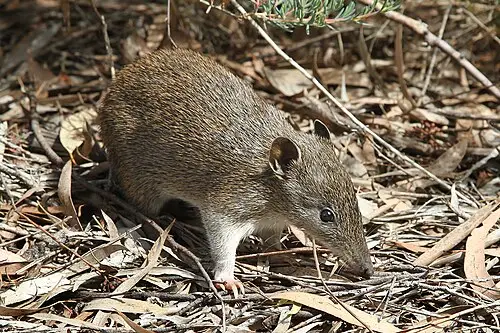
 📸 Photo
Photo: John O'Neill (jjron) You can contact me about this image, its re-use, or to make a gratuity (donation) by leaving a message on my talkpage or by sending me an e · Public domain · Wikimedia Commons Source
Southern Brown Bandicoot
Isoodon obesulus (Southern Brown Bandicoot · チャイロコミミバンディクート)
💡 Everyday Comparisons for Size, Mass & Speed
- 💡 A male's maximum weight of 1.85 kg is slightly lighter than a 2 L bottle of water (about 2 kg), and its maximum length of 50 cm is about 1.7 times the long side of an A4 sheet of paper (Comparison).
- 💡 It gathers grass and brush to build a nest over a shallow hollow in the ground or an abandoned rabbit burrow.
Reference standards: coach bus ~12 m, mid-size car ~4.9 m, compact car ~1 t, basketball hoop 3.05 m, credit card 8.56 cm.
Site-computed relative index from recorded values; not a formal scientific metric.
📖 1. Overview
The Southern Brown Bandicoot is a marsupial living in southern Australia and Tasmania, commonly found in dense scrub near the sea, lakes, and streams.
🦴 2. Anatomy & Morphology
Males continue growing throughout their lives, whereas females stop growing around 18–24 months of age. Its tail makes up about 40% of its body size, though individuals with shortened or missing tails from fighting between males are common.
🔍 3. Ecology & Behavior
It digs small holes in the ground to eat invertebrates such as ants, beetles, earthworms, centipedes, and crickets, as well as plants and fungi. Mainly nocturnal, it is also active during the day in winter, and gathers brush and plant matter to build a nest over a shallow hollow.
🇰🇷 4. Connection to Korea
No direct record connecting this species to Korea has been found.
📚 Sources & References
- • IUCN Red List LC (2016) — https://www.iucnredlist.org/species/40553/115173603
- • IUCN Red List category LC — latest assessment at iucnredlist.org
- • mammaldiversity.org — 1000236
- • iucnredlist.org — 115173603
- • wikidata.org — Q194151
- • commons.wikimedia.org — File:Southern Brown Bandicoot (Isoodon obesulus) 2, Vic, jjr
- • animaldiversity.org — Isoodon obesulus
- • Silhouette: PhyloPic — Kawinwit Kittipalawattanapol · CC0 1.0
Recorded dimensions are widely cited representative estimates from public literature and may vary by study or specimen.