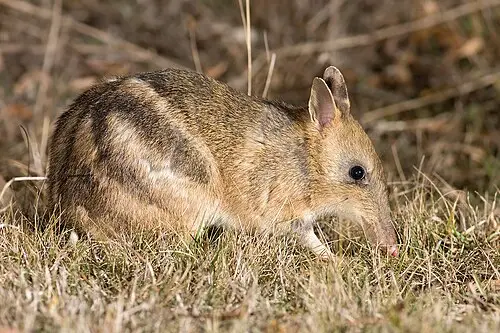
 📸 Photo
Photo: JJ Harrison ( https://www.jjharrison.com.au/ ) · CC BY-SA 3.0 · Wikimedia Commons Source
Eastern Barred Bandicoot
Perameles gunnii (Eastern Barred Bandicoot · ヒガシシマバンディクート)
💡 Everyday Comparisons for Size, Mass & Speed
- 💡 Its average weight of 640 g is about 2/3 of a 1 L milk carton, and its head-and-body length of 34 cm is slightly longer than the long side of A4 paper (29.7 cm) (Comparison).
- 💡 It has been reported moving into gardens, cemeteries, and car dumps, and feeds on beetles and grubs that harm lawns and fields.
Reference standards: coach bus ~12 m, mid-size car ~4.9 m, compact car ~1 t, basketball hoop 3.05 m, credit card 8.56 cm.
Site-computed relative index from recorded values; not a formal scientific metric.
📖 1. Overview
The Eastern Barred Bandicoot is a small marsupial living in the grasslands of Australia and Tasmania, named after the pale bars on its back. It is assessed as Vulnerable (VU) on the IUCN Red List.
🦴 2. Anatomy & Morphology
Its head is long and slender, tapering to a pink nose, with large rabbit-like ears. Its greyish-brown fur is very soft with pale stripes across the torso and hindquarters, and its belly is creamy white.
🔍 3. Ecology & Behavior
Using its nose and claws, it digs small conical holes in the ground to feed mainly on soil invertebrates such as root-eating grubs, cockchafers, and earthworms. It is nocturnal and solitary, sometimes galloping with jumps of 1 m at a time, and has a high reproductive rate.
🇰🇷 4. Connection to Korea
No direct record connecting this species to Korea has been found.
📚 Sources & References
- • IUCN Red List VU (2016) — https://www.iucnredlist.org/species/16572/21966027
- • IUCN Red List category VU — latest assessment at iucnredlist.org
- • mammaldiversity.org — 1000241
- • iucnredlist.org — 21966027
- • wikidata.org — Q856593
- • commons.wikimedia.org — File:Perameles gunni.jpg
- • animaldiversity.org — Perameles gunnii
- • Silhouette: PhyloPic — Rachel T Mason · CC0 1.0
Recorded dimensions are widely cited representative estimates from public literature and may vary by study or specimen.