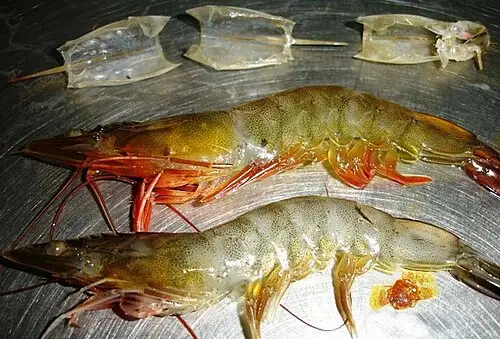
 📸 Photo
Photo: Herman Gunawan, Bangka, Indonesia. · CC BY-SA 3.0 · Wikimedia Commons Source
Whiteleg shrimp
Penaeus vannamei (Whiteleg shrimp · Whiteleg shrimp)
Not Evaluated (NE) on the IUCN Red List yet.
💡 Everyday Comparisons for Size, Mass & Speed
- 💡 A maximum body length of 23 cm is 2 cm longer than the short side of an A4 sheet of paper (21 cm) (Comparison).
- 💡 The Food and Agriculture Organization (FAO) notes that Asian production of whiteleg shrimp reached about 1.11 million tonnes in 2004, surpassing Penaeus monodon (black tiger shrimp) in China, Taiwan, and Thailand. It is the most important species in the farmed shrimp market.
Reference standards: coach bus ~12 m, mid-size car ~4.9 m, compact car ~1 t, basketball hoop 3.05 m, credit card 8.56 cm.
📖 1. Overview
The whiteleg shrimp is native to the eastern Pacific coast from Sonora, Mexico to Tumbes, Peru, and is now the most widely farmed shrimp in the world.
🦴 2. Anatomy & Morphology
Its rostrum is of medium length with 7–10 teeth on the upper margin and 2–4 on the lower margin. The body is usually translucent white, but its color changes depending on the substrate, diet, and water turbidity. Females generally grow faster and larger than males.
🔍 3. Ecology & Behavior
Adults live and spawn offshore, while juveniles migrate toward the coast to grow in estuaries, lagoons, and mangroves. They feed on bottom detritus, worms, bivalves, and crustaceans, and a 30–45 g female lays 100,000–250,000 eggs.
🇰🇷 4. Connection to Korea
No direct record connecting this species to Korea has been found.
📚 Sources & References
- • IUCN Red List: not evaluated (NE) — cross-checked with the Wikidata conservation-status entry
- • marinespecies.org — aphia.php
- • wikidata.org — Q63708469
- • commons.wikimedia.org — File:Litopenaeus vannamei specimen.jpg
- • fao.org — en whitelegshrimp.htm
- • sealifebase.se — Penaeus-vannamei.html
- • Silhouette: PhyloPic — Christoph Schomburg · CC0 1.0 (Congeneric silhouette — Penaeus)
Recorded dimensions are widely cited representative estimates from public literature and may vary by study or specimen.