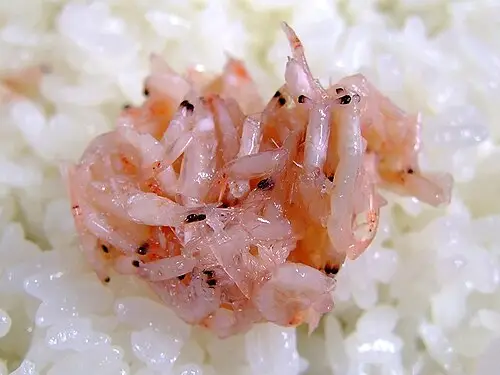
 📸 Photo
Photo: Siriusplot · CC BY-SA 3.0 · Wikimedia Commons Source
Akiami paste shrimp
Acetes japonicus (Akiami paste shrimp · アキアミ)
Not Evaluated (NE) on the IUCN Red List yet.
💡 Everyday Comparisons for Size, Mass & Speed
- 💡 A female's body length of 3 cm is slightly longer than the diameter of a Korean 500-won coin (about 2.65 cm) (Comparison).
- 💡 SeaLifeBase classifies this shrimp as a commercial fishery species, and the National List of Species of Korea records specimens caught in set nets off Tongyeong, meaning it is a small shrimp harvested with stationary nets set in the sea.
Reference standards: coach bus ~12 m, mid-size car ~4.9 m, compact car ~1 t, basketball hoop 3.05 m, credit card 8.56 cm.
📖 1. Overview
The Akiami paste shrimp is a small shrimp living in shallow Indo-West Pacific coastal waters from Japan and China to Southeast Asia and southern India, and is also recorded in the Yellow and South Seas of Korea.
🦴 2. Anatomy & Morphology
Its body is translucent with one red spot on the protopodite and one on the endopod of the uropod. The rostrum is pointed with 2 small teeth on the upper margin, and the eyes are relatively short.
🔍 3. Ecology & Behavior
It swims in the water column feeding on phytoplankton and zooplankton. It lives in water above muddy seafloors and is also found in mangrove areas.
🇰🇷 4. Connection to Korea
The National List of Species of Korea records it from Gyeonggi-do, Chungcheongnam-do, Gyeongsangnam-do, Jeollabuk-do, and Jeollanam-do, including specimens caught in a set net in Tongyeong, Gyeongsangnam-do in 2012.
📚 Sources & References
- • IUCN Red List: not evaluated (NE) — cross-checked with the Wikidata conservation-status entry
- • marinespecies.org — aphia.php
- • 국가생물종목록(국립생물자원관) ktsn 120000049324 — https://species.nibr.go.kr/home/mainHome.do?cont_link=009&subMenu=009002&contCd=009002&ktsn=120000049324
- • wikidata.org — Q4478218
- • commons.wikimedia.org — File:Akahige shiokara.jpg
- • sealifebase.se — Acetes-japonicus.html
- • species.nibr.go.kr — mainHome.do
Recorded dimensions are widely cited representative estimates from public literature and may vary by study or specimen.