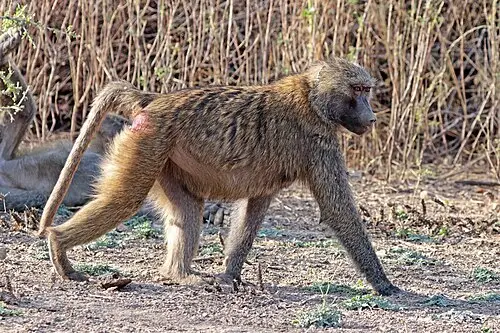
 📸 Photo
Photo: Charles J. Sharp · CC BY-SA 4.0 · Wikimedia Commons Source
Hamadryas Baboon
Papio hamadryas (Hamadryas Baboon · マントヒヒ)
💡 Everyday Comparisons for Size, Mass & Speed
- 💡 A male's weight of about 21.5 kg is slightly more than a 20 kg bag of rice (Comparison).
- 💡 In parts of Ethiopia it visits farmlands and is regarded as a crop pest, while on the Arabian Peninsula troops attract tourists (ADW).
Reference standards: coach bus ~12 m, mid-size car ~4.9 m, compact car ~1 t, basketball hoop 3.05 m, credit card 8.56 cm.
Site-computed relative index from recorded values; not a formal scientific metric.
📖 1. Overview
The Hamadryas Baboon is a baboon living in dry lands with waterholes and sleeping cliffs, and males have a lush silver mane.
🦴 2. Anatomy & Morphology
Males have a grayish-brown body, colorful skin on the face and muzzle, and cheek hair that blends into a full silver mane. Females are much smaller, plain olive-brown, and have a muted grayish-brown face.
🔍 3. Ecology & Behavior
It eats whatever it can find, including fruits, tree gums, insects, acacia seeds and flowers, grasses, and roots. It moves in one-male units of 2–23 individuals in which a single male herds 1–9 females and their young.
🇰🇷 4. Connection to Korea
No direct record connecting this species to Korea has been found.
📚 Sources & References
- • IUCN Red List LC (2019) — https://www.iucnredlist.org/species/16019/17953082
- • IUCN Red List category LC — latest assessment at iucnredlist.org
- • mammaldiversity.org — 1000630
- • iucnredlist.org — 17953082
- • wikidata.org — Q189484
- • commons.wikimedia.org — File:Hamadryas baboon (Papio hamadryas) female.jpg
- • animaldiversity.org — Papio hamadryas
- • Silhouette: PhyloPic — unknown · Public Domain Mark 1.0 (Congeneric silhouette — Papio)
Recorded dimensions are widely cited representative estimates from public literature and may vary by study or specimen.