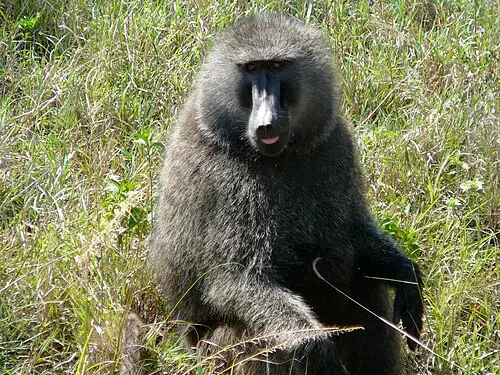
 📸 Photo
Photo: ryan harvey from Portland, OR · CC BY-SA 2.0 · Wikimedia Commons Source
Olive Baboon
Papio anubis (Olive Baboon · アヌビスヒヒ)
💡 Everyday Comparisons for Size, Mass & Speed
- 💡 A male's weight of about 25 kg is about one and a half 20 kg bags of rice (Comparison).
- 💡 Its active social life entertains zoo visitors and ecotourists, and it is also used in medical and behavioral research (ADW).
Reference standards: coach bus ~12 m, mid-size car ~4.9 m, compact car ~1 t, basketball hoop 3.05 m, credit card 8.56 cm.
Site-computed relative index from recorded values; not a formal scientific metric.
📖 1. Overview
The Olive Baboon is a terrestrial monkey living in grasslands and forests of Africa, and males have a large mane.
🦴 2. Anatomy & Morphology
Males and females differ greatly in size, and the olive-gray coat is formed by hairs with alternating black and yellowish-brown rings. Males have large canine teeth and a heavy mane over the shoulders.
🔍 3. Ecology & Behavior
An omnivore that eats fruits, tree gums, insects, eggs, seeds, grass roots, and small vertebrates, it can also subsist on grass alone for long periods. Troops of 39–97 individuals travel together and sleep in trees or on rocks.
🇰🇷 4. Connection to Korea
No direct record connecting this species to Korea has been found.
📚 Sources & References
- • IUCN Red List LC (2020) — https://www.iucnredlist.org/species/40647/17953200
- • IUCN Red List category LC — latest assessment at iucnredlist.org
- • mammaldiversity.org — 1000628
- • iucnredlist.org — 17953200
- • wikidata.org — Q208561
- • commons.wikimedia.org — File:Male Olive Baboon 2.jpg
- • animaldiversity.org — Papio anubis
- • Silhouette: PhyloPic — Margot Michaud · CC0 1.0
Recorded dimensions are widely cited representative estimates from public literature and may vary by study or specimen.