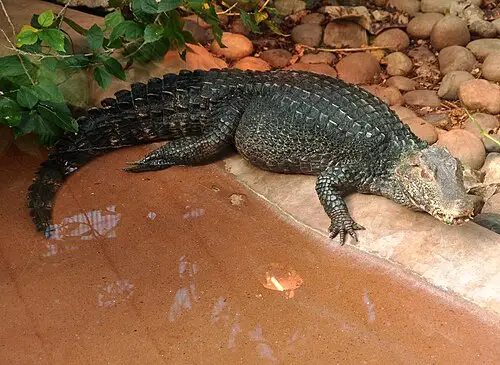
 📸 Photo
Photo: Nilfanion · CC BY-SA 3.0 · Wikimedia Commons Source
Cuvier's Dwarf Caiman
Paleosuchus palpebrosus (Cuvier's Dwarf Caiman · コビトカイマン)
💡 Everyday Comparisons for Size, Mass & Speed
- 💡 A maximum length of 1.5 m is slightly shorter than an adult human's height (about 1.7 m), and a maximum weight of 7 kg is 70% of a 10 kg bag of rice (Comparison).
- 💡 Although its meat tastes good, it yields too little, and its small, tough hide is unpopular in the leather industry; however, its small, seemingly manageable size makes it popular in the pet trade (positive impacts on humans in ADW).
Reference standards: coach bus ~12 m, mid-size car ~4.9 m, compact car ~1 t, basketball hoop 3.05 m, credit card 8.56 cm.
Site-computed relative index from recorded values; not a formal scientific metric.
📖 1. Overview
Cuvier's Dwarf Caiman is the smallest species in the alligator family and lives in clear, fast-flowing forest streams of South America. Its IUCN assessment is Least Concern (LC) as of 2019.
🦴 2. Anatomy & Morphology
Its body is reddish brown with a mostly plain, nearly black back, dark and light spots on the upper and lower jaws, and encircling bands on the tail. Whereas other caimans have 5 premaxillary teeth in the upper jaw, this species has 4.
🔍 3. Ecology & Behavior
A nocturnal hunter that catches tadpoles, frogs, snails, fish, small mammals, and insects at night, it basks during the day. It usually goes alone or in pairs, breeds at the end of the dry season, and mates in shallow water at night.
🇰🇷 4. Connection to Korea
No direct record connecting this species to Korea has been found.
📚 Sources & References
- • IUCN Red List LC (2019) — https://www.iucnredlist.org/species/46587/3009946
- • IUCN Red List category LC — latest assessment at iucnredlist.org
- • catalogueoflife.org — 4C47J
- • iucnredlist.org — 3009946
- • wikidata.org — Q757363
- • commons.wikimedia.org — File:Dwarf Caiman in Paignton Zoo.jpg
- • animaldiversity.org — Paleosuchus palpebrosus
- • Silhouette: PhyloPic — author not recorded · CC0 1.0
Recorded dimensions are widely cited representative estimates from public literature and may vary by study or specimen.