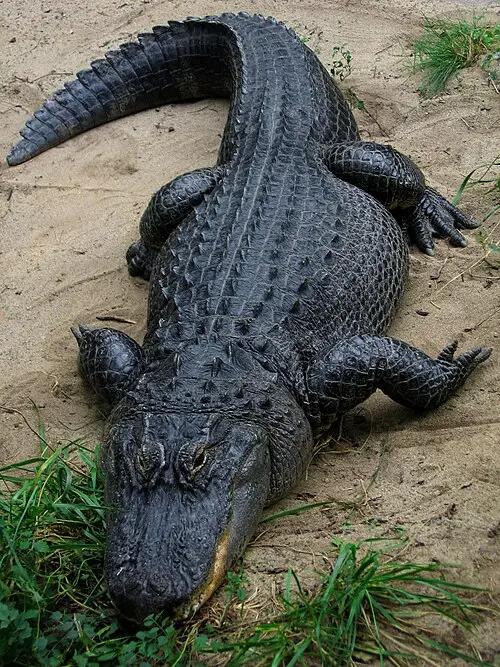
 📸 Photo
Photo: User:Postdlf · CC BY-SA 3.0 · Wikimedia Commons Source
American Alligator
Alligator mississippiensis (American Alligator · アメリカアリゲーター)
💡 Everyday Comparisons for Size, Mass & Speed
- 💡 Its maximum length of 4.37 m is almost equal to the length of a passenger car (about 4.5 m), and its maximum weight of 360 kg equals eighteen 20 kg bags of rice (Comparison).
- 💡 It has been hunted for its meat, hide, and teeth—with hides used for boots and jackets and teeth for jewelry, buttons, and cane handles—and is also a major zoo and ecotourism attraction in Florida (ADW 'Economic Importance for Humans: Positive').
- 💡 At the Smithsonian National Zoo, they are fed rats and occasionally rabbits (Smithsonian National Zoo).
Reference standards: coach bus ~12 m, mid-size car ~4.9 m, compact car ~1 t, basketball hoop 3.05 m, credit card 8.56 cm.
Site-computed relative index from recorded values; not a formal scientific metric.
📖 1. Overview
The American Alligator is an alligator living in freshwater swamps, rivers, and ponds of the southeastern United States; because it has low tolerance for salt, it lives mostly in fresh water. Its IUCN status is Least Concern (LC, as of 2019).
🦴 2. Anatomy & Morphology
It has an armored body with bony plates embedded in the back, a flattened muscular tail, and a rounded snout with upturned nostrils at the tip that allow it to breathe while submerged. Young alligators have bright yellow stripes on the tail, and adult males are larger than females.
🔍 3. Ecology & Behavior
It is a carnivore feeding on fish, snails, birds, frogs, and mammals that come to the water's edge, with jaws strong enough to crush turtle shells. It shakes or spins its body to tear apart large prey, and digs mud basins called 'gator holes' as safe refuges.
🇰🇷 4. Connection to Korea
No direct record connecting this species to Korea has been found.
📚 Sources & References
- • IUCN Red List LC (2019) — https://www.iucnredlist.org/species/46583/3009637
- • IUCN Red List category LC — latest assessment at iucnredlist.org
- • catalogueoflife.org — BTRB
- • iucnredlist.org — 3009637
- • wikidata.org — Q193327
- • commons.wikimedia.org — File:American Alligator.jpg
- • animaldiversity.org — Alligator mississippiensis
- • nationalzoo.si.edu — american-alligator
- • Silhouette: PhyloPic — Edwin Price · CC BY 4.0
Recorded dimensions are widely cited representative estimates from public literature and may vary by study or specimen.