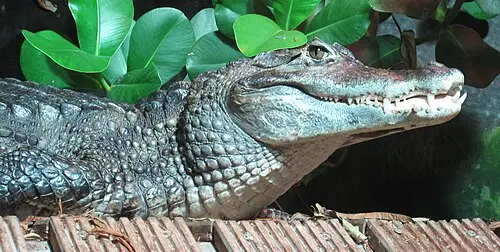
 📸 Photo
Photo: This photo has been taken by Matthieu Sontag (User:Mirgolth) and released under the licenses stated below. You are free to use it for any purpose as long as you · CC BY-SA 3.0 · Wikimedia Commons Source
Spectacled Caiman
Caiman crocodilus (Spectacled Caiman · メガネカイマン)
💡 Everyday Comparisons for Size, Mass & Speed
- 💡 Its maximum length of 3 m is about 2/3 the length of a passenger car (about 4.5 m), and its maximum weight of 58 kg is close to three 20 kg bags of rice (Comparison).
- 💡 Within its native range it is the crocodilian most heavily harvested for the leather industry and is also sold in the pet trade (ADW 'Economic Importance for Humans: Positive').
Reference standards: coach bus ~12 m, mid-size car ~4.9 m, compact car ~1 t, basketball hoop 3.05 m, credit card 8.56 cm.
Site-computed relative index from recorded values; not a formal scientific metric.
📖 1. Overview
The Spectacled Caiman is a small- to medium-sized crocodilian living in slow-moving rivers and wetlands of the Central and South American tropics, and is the most common crocodilian in its range. Its IUCN status is Least Concern (LC, as of 2019).
🦴 2. Anatomy & Morphology
Adults are dull olive to nearly black with yellow crossbands and a long snout. A bony ridge (infra-orbital bridge) between the eyes distinguishes it from other crocodilians living in the same regions.
🔍 3. Ecology & Behavior
It is a carnivore with more than 105 recorded prey items, including insects, snails, shrimp, crabs, fish, lizards, snakes, turtles, birds, and mammals. It feeds mainly at night and stays submerged during midday heat, defending territories in the breeding season where larger individuals hold higher rank.
🇰🇷 4. Connection to Korea
No direct record connecting this species to Korea has been found.
📚 Sources & References
- • IUCN Red List LC (2019) — https://www.iucnredlist.org/species/46584/3009688
- • IUCN Red List category LC — latest assessment at iucnredlist.org
- • catalogueoflife.org — PBBP
- • iucnredlist.org — 3009688
- • wikidata.org — Q272582
- • commons.wikimedia.org — File:Caiman crocodilus Nausicaa.jpg
- • animaldiversity.org — Caiman crocodilus
- • Silhouette: PhyloPic — An Ignorant Atheist · CC0 1.0 (Related taxon silhouette — Alligatoridae)
Recorded dimensions are widely cited representative estimates from public literature and may vary by study or specimen.